Photo by Pasi Nevalaita
Cult British filmmaker Ben Wheatley once said that each decade we enter feels either like the seventies or the eighties. If the former, it’s edgy, down-at-heel, gritty and somewhat paranoid; if the latter, ostentatious, fast, venal and flashy. It would be hard to argue that the 2020s feel like the eighties, but in the case of Finland’s Hooded Menace, they are on a neon highway back to the decade where greed was good, and biting, burnished heavy metal music held sway.
Though the eighties have returned to the aesthetics and sound of bands like Unto Others and Sumerlands, it’s harder to see how it might be incorporated into the death-doom subgenre. Turgid, processional guitars, roared vocals and cavernous drums don’t scream wired-for-speed decadence, do they? But slowly, surely, the eighties has crept into the sonic palette of Hooded Menace, first in the short instrumental “Black Moss” from 2018’s Ossuarium Silhouettes Unhallowed, then in what founding guitarist and songwriter, Lasse Pyykkö, calls its “full form” on 2021’s The Tritonus Bell.
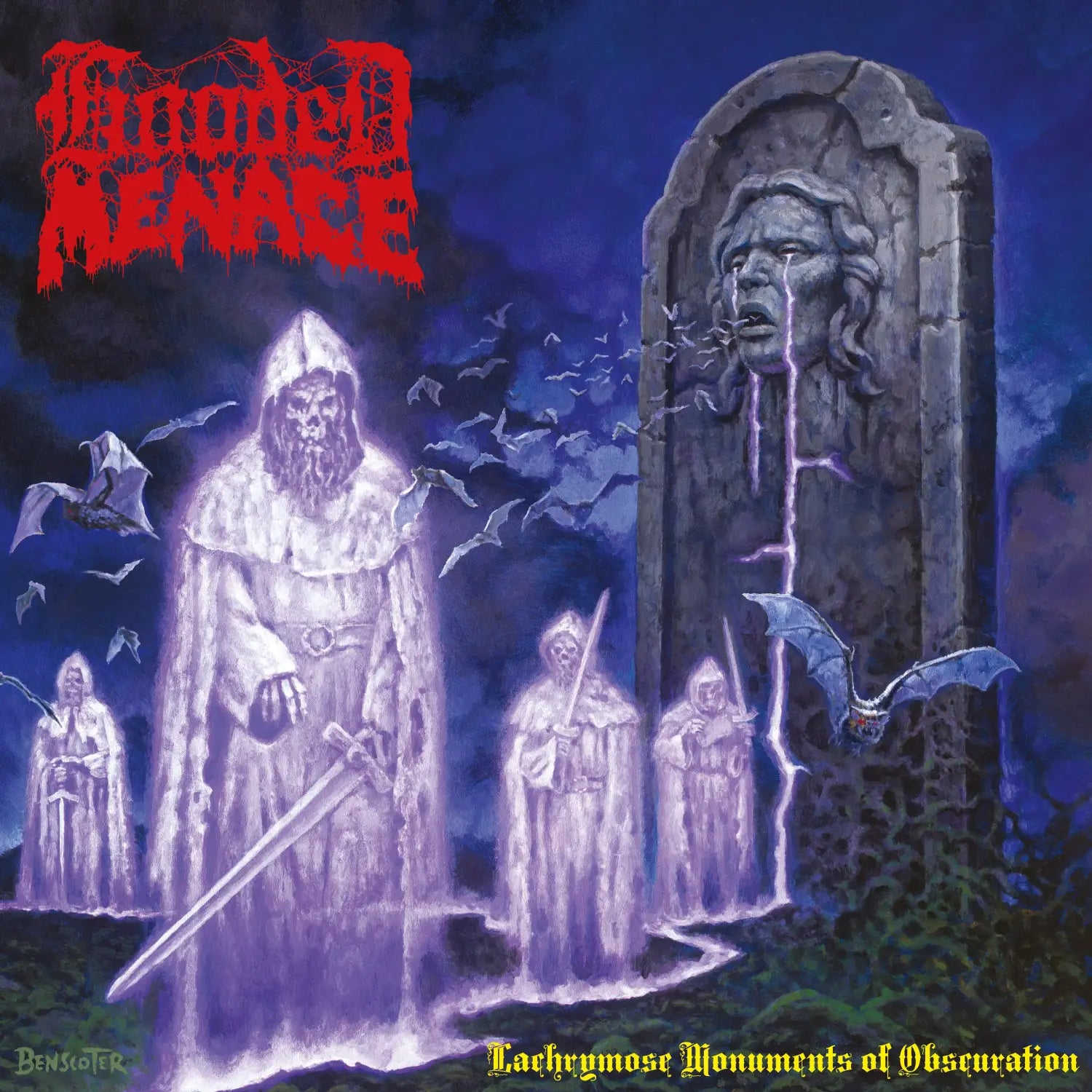
That album pushed further, and also backwards, into the band’s eighties heavy-metal influences, and now their sonic palette has developed yet further with their seventh full-length, Lachrymose Monuments of Obscuration.
“I think it’s great and natural to start digging deeper and deeper into where you are coming from,” says band architect Lasse Pyykkö. “Because that stuff has always been there, and it feels totally natural to navigate in that direction.”
Pyykkö himself has been a stalwart on the Finnish metal scene since the late eighties. Even back then, he wondered what classic Swedish doomers Candlemass might sound like with growled vocals, but thought it was too preposterous to attempt. His band Phlegethon pursued a death-thrash sound which was erupting like molten lava everywhere up from the underground, from Stockholm to Tampa. But the germ of that crossover idea never left him, and in 2007 he formed Hooded Menace, which made an instant impact in the darker recesses of the death-doom scene with 2008’s Fulfill the Curse and 2010’s Never Cross the Dead.
The nominal menace in question are the hooded, eyeless and skeletal knights templar, risen from the grave in Amando de Ossorio’s 1972 cult horror classic Tombs of the Blind Dead. The film spawned three sequels and was a huge influence on the doom-metal scene: from the lyrics of Cathedral’s classic “Night of the Seagulls”, through to new (oc)cult favourites Green Lung’s “Templar Dawn”.
The blind dead have recurred on the artwork of all the Hooded Menace releases, though their lyrical influence has waned as the band has progressed. The band's lyrics have transitioned into more dreamlike, ambiguous “dark poetry” (Pyykkö's description) from the straight storytelling of the early albums. Back then, the lyrics were written by a team of “buddies” associated with the band’s first label, Razorback Records. You can play spot-the-horror-movie in their early songs, made easier on 2012's Effigies of Evil by film samples from 1971’s Twins of Evil and 1960 Poe adaptation and Vincent Price vehicle, House of Usher. But now, Lachrymose Monuments of Obscuration brings Pyykkö full circle lyrically, harking back to the oneiric visions conjured by the art of Salvador Dali in the lyrics of Phlegethon.
“The lyrics are influenced by everything otherworldly and dark and horror films, and then go through our filters and come out a little bit more surreal and abstract,” says Pyykkö.
Though the music takes longer to write (weeks versus days), Pyykkö, vocalist Harri Kuokkanen and drummer Teemu Hannonen sweat the lyrics a little more, piecing them together in stages. The results, such as the words of “Lugubrious Dance”, are dipped in a malevolent, nightmarish dread, hinting at another realm pressing into ours: “Otherworldliness/In the shreds of reality/Where the veils are obscured”.
“Lugubrious Dance” encapsulates the thrust of the album in miniature. It sets forth with a strident tempo, as Kuokkanen recalls the delivery of Tom G. Warrior (frontman of Celtic Frost and Triptykon), before incorporating classic-rock flourishes and settling into a Mob Rules-era Sabbathian stomp. This is not the plodding morosity often associated with the death-doom genre.
The riffs wind and wend depending on where they take Pyykkö. He doesn’t keep a bank of riffs, instead relying on instinct and feel, as well as his effects, to shape his musical direction. He has incorporated what he calls the “micro-pitching” of Sammy Hagar-era Van Halen into the production; a widescreen sound with the classic chorus-pedal sheen of eighties hard rock, and one guitar in each channel. Pyykkö simply wouldn’t be able to write this kind of music with the crushing tone of his earlier albums.
“You can’t really get that sharp, tight, heavy-metal eighties sound from that tone – it's all for the doomy stuff,” he says.
Pyykkö stopped doing the band’s vocals after 2015’s Darkness Drips Forth. When he demos the band’s material it is in virtually final form, with him providing guide vocals. But the demands of the more uptempo material on songs like “Pale Masquerade” would have found him restricted in his playing, and restricting the material overall, if he had continued with his gutturals.
“I understand why some people were quite disappointed with Harri on vocals, because they – for some reason – like my voice so much,” he says. “But when you think about the faster pace of some of these songs, my voice doesn’t have the dynamics to do those faster parts, so that's one of the reasons we got Harri.”
Though what Pyykkö calls the “red thread” of horror culture still runs through Lachrymose Monuments of Obscuration, there is one big cultural surprise: a cover of Duran Duran’s “Save A Prayer” from their 1982 album, Rio. Hooded Menace previously covered W.A.S.P.’s “The Torture Never Stops” on The Tritonus Bell, but this is a more audacious cover choice. Pyykkö confesses to “digging” Duran Duran at ten years old, when he was predominantly listening to Iron Maiden and Accept. He would sneak into his older sister’s room to borrow her cassette tape of Rio and the melancholic synths of “Save A Prayer” stayed with him.
“I think a lot of eighties pop songs, even disco songs, have a really dark vibe to them – it's kind of different from what we have now [in pop],” he says.
That makes sense. The cold synth pop of The Human League, Ultravox, and the relatively more upbeat music of Duran Duran, emerged in late seventies/early eighties England, where New Romanticism and the Gothic were close bedfellows. Archetypal goth rockers Sisters of Mercy were formed in Leeds in the 1980s, a kind of glacial hangover from post-punk. A decade later, the region would produce the “Peaceville Three” trio of original death-doom bands: Paradise Lost, My Dying Bride and Anathema.
Pyykkö was wary of the Duran Duran cover sounding too “cheesy” with death-metal growls, so he retained a lot of the original vocal line in the guitar leads, echoing throughout the song. It works remarkably well in the context of the rest of the album.
“I think it almost sounds like a song that should be somewhere on Paradise Lost’s [1993] Icon album, right? They didn't do it, so we did it,” he smiles.
Scandinavia and England were connected thousands of years ago by a large area of land known as Doggerland, before it was submerged by the North Sea. It’s hard not to see a shared (maybe even ancient) heritage of gloomy music, commensurate with the dreary climate of these countries, whether it is in pop and metal. But in recent years, Finland has repeatedly been called the happiest country in the world – so why is its music so downbeat?
“I think it's the Russian influence,” says Pyykkö. “Because a lot of those melodies are quite similar to today’s music, and it's not like we have always been the happiest country. You know, it's just been the last few decades. Life in the eighties was still quite grimy, living in the shade of war, and all the memories of war. Scared of doing things – worrying what the neighbor [Russia] thinks about it, right?”
If Pyykkö had some trepidation about “Save A Prayer” taking Hooded Menace too boldly into Paradise Lost territory, he was surprised by how effective using a traditional instrument like the cello was on “Portrait Without a Face” and crushing finale “Into Haunted Oblivion”. Played by former live bassist Antti Poutanen, the cello has a romantic, classical sound with shades of death-doom's other scene progenitors, My Dying Bride, that cuts through the thick morass of their sound with plaintive incision.
“In the beginning, in the early days of Hooded Menace, I would have laughed if someone suggested we use cello, because we wanted to be bare-bones death-doom – not even seven-string guitars or five-string bass,” says Pyykkö.
Hooded Menace have shed the manacles they used to restrict themselves in the past. In widening their sound and reaching back to the past, and beyond genre boundaries, they have beaten a new path into the unknown which promises to open up new vistas for the band.
If the risk of trying to improve the formula of songs like Ossuarium’s heavier-than-thou “Charnel Reflections” meant blindly trudging in circles, Pyykkö has done well to look backwards in order to go forward. He has raised his hood to reveal a band as fearless as they are menacing.
-----
Lachrymose Monuments of Obscuration from Hooded Menace arrives October 3rd via Season of Mist. Order the album - HERE