Story by Maddy Howell / Photo by Wyatt Clough
For two decades, The Devil Wears Prada have walked a tightrope between blistering heaviness and aching melody. Unafraid to stare down depression, faith, anxiety, and mortality with gut-wrenching emotion as their weapon, they’ve built up a catalogue that refuses to shy away from the darkest corners of the mind - yet always strives for something hopeful on the other side.
Establishing themselves as one of metalcore’s most enduring forces with 2009’s With Roots Above and Branches Below and its 2011 follow-up Dead Throne, 2022’s Color Decay marked a creative turning point for the Dayton, Ohio heavyweights. Thought-provoking, anthemic, and glistening with glitchy electronics, it was a bold experiment that propelled them to their biggest stages yet.
Pushing the limits further still, the band’s ninth album Flowers processes grief, faith, intrusive thoughts, and the emptiness that success can’t quite fill – all while sounding purpose-built for the biggest rooms of their career. Written in part during a secluded stay in a rental house in Rogers, Arkansas, and finished across multiple trips to Los Angeles, the record finds keyboardist Jonathan Gering at the production helm, with collaborators including Tyler Smyth, Austin Coupe, Colin Brittain, Fit For A King’s Bobby Lynge, and Marshall Gallagher.
To celebrate its release, we sat down with guitarist/vocalist Jeremy DePoyster to talk about Prada’s creative reset, their embrace of collaboration, and why, if it all disappeared tomorrow, he’d still sleep easy knowing they did everything their own way.
This new chapter feels like a continuation of what you started with Color Decay. Coming into Flowers, what kind of creative vision did you have?
DePoyster – When we had wrapped up Color Decay, I remember sitting on a porch in Palm Springs, California looking out at the desert. I was thinking how this could all blow up in our faces, because that album was so different from a lot of stuff that we'd done before.
The reception was so good though. We poured our hearts into that record, and people received it well. I think the goal with Flowers was just to push that even further, to see how far we could push things before they break. Somehow, it hasn't broken yet.
It’s a rare position to be in when you’re two decades deep and things are still growing. Did you find yourself reflecting on the band’s journey as you came into this era?
DePoyster – Yeah, big time. We played the Warped Tour in Orlando recently, and just seeing A Day To Remember there, and thinking about Bring Me The Horizon and so many of those other bands… We were literally all kids when we started out on this journey. Our ceiling was so low in terms of where we thought this whole thing would end up, so seeing all of our peers move into bigger rooms and get played on the radio is crazy. That was not even a dream that we knew to have back then.
Because of that, why would we not just make whatever records we want? If it goes away, it was never supposed to be here in the first place. At least I can sleep at night knowing we've done whatever we wanted.
Let’s go back to the early stages of Flowers. It feels like there were a lot of stages involved in creating this album, from writing sessions in LA to a retreat in Arkansas. Talk us through the journey…
DePoyster – It was awesome. We did a bunch of trips out to LA where we brought some other writers into the room with us to start cooking stuff up. A lot of people think that just means you go and grab a song from somebody and record it, but it's just one more voice in a room while you write your own song. It was very similar to how it's always been, just with different people in the room.
We had a bunch of those sessions over the last couple of years, and then we had a peaceful retreat to Arkansas. Just a couple of us were out there, and our photographer. It was nice to not have the pressure of being in a studio and having to work. It's not very creative to be in a workplace, if that makes sense. Being out there was peaceful, and I could just sit on the porch, have conversations with Mike [Hranica] for hours, and then be like, ‘Let's make that into a song.’
At this point in your career, those friendships are also central to everything you do. Early on you can maybe just push through if you’re not all on the same page, but 20 years in you have to want to be there together. How important is it for you that everyone in the band has each other’s backs and is friends first?
DePoyster – Hugely. People really only see us on stage, but we spend 99% of our days just hanging out with each other, doing bits, and looking at stupid Instagram Reels together. We go out to eat together, and most of our time is spent just hanging out together. I think if that doesn't work, you can feel that chemistry on stage. It’s important to us to keep those relationships tight.
Fans can tell when a band isn’t in a good place – it comes out in the live show, and it comes out in the records. With Flowers, you’re also digging into some really heavy, personal territory again: depression, anxiety, faith, mortality. To do that, you need to feel safe in the room together. When you’re approaching a record from that perspective – something this personal and deep – how much does that trust come into play in being able to open up?
DePoyster – I think it's really important. It's almost like a therapy session where you're saying things out loud that you wouldn't normally say in mixed company, expressing your most interpersonal feelings. It’s nice though because other people in the room will be like, ‘Oh, I kind of feel that way too,’ and elaborate on it.
To me, that's what has been so important about Color Decay and this record. Even more than the sonics, I'll have people DM me all the time and be like, ‘I was struggling with this thing, and this song helped me because you were honest in it. You didn't try to candy-coat it.’ I don't think I'll be looking at my motorcycle and my guitars when I'm old and saying, ‘Oh, thank God, I’ve got those.’ It's more about whether you leave the world better than how you found it. That sounds pretentious, but it’s that simple idea of trying to do some good while we're here.
That really comes through on ‘Where The Flowers Never Grow’, which people have gravitated towards in such a big way. It’s all about acknowledging that darkness in our minds and trying to find some kind of peace with it…
DePoyster – That song is basically about this part of your mind when all the hype and the allure and the stimulus is gone, and you're left alone. It's this dark place that you can't help but find yourself in. It’s empty, barren, and you're forced to confront your demons. From that point in the record, the very beginning, it starts to descend into these different layers. It’s about trying to cope with it and trying to mask it. I'm in a great place right now, but I've definitely had those demons before, and it's just trying to be honest about those. That song is the launch point for ‘How bad can it get?’
Something that amplifies that is the short film That Same Place Where The Flowers Never Grow. It takes that idea and blows it out visually. How involved were you in shaping that narrative – was it a full band effort?
DePoyster – Yeah, big time. Wyatt [Clough], who directed that video, did all of the videos for this record. We had a vision of this short film, and I pitched an idea of what I thought I wanted it to be. He was like, ‘I like some of your ideas, but what if this is really what you're trying to do?’
We came up with this cult idea of these bad thoughts. These things that are trying to convince you to go back down with them, and you just can't help it. You end up going back down there again, even if it doesn't serve you. It's a roller coaster.
That idea of a roller coaster is actually a great way to describe the album as a whole. There’s this whole journey through the ups and downs, moments of lightness and moments of real darkness…
DePoyster – We did a record called Dead Throne in 2011 with Adam [Dutkiewicz] from Killswitch Engage, and that was the first time we had really put together a dynamic within the sound of songs on the record. He was really encouraging about some more ballad-driven stuff that we had and about breaking up different styles of songs. We had this big whiteboard with a bunch of different types of songs, and it almost wrote a story for itself. You started to see the pieces all fit together in a crazy way. Especially sonically, we’re now always thinking about how we can be on a journey and not get bored. We never want someone to feel like, ‘Didn't I just hear that on the last song?’ We want it to feel like a trip.
Songs like ‘Everybody Knows’ and ‘Where The Flowers Never Grow’ are very much in that isolated headspace – being seen when you’re falling apart, being perceived when things are going wrong. From the outside, you’re constantly in front of people, traveling the world, having the best time. How do you tap into the loneliness behind that perception in a song?
DePoyster – I feel like both things are kind of happening at once, right? I love playing shows, and they are better than ever right now. I love going out with my friends and exploring the world and having all these crazy experiences. Simultaneously, you also really miss your partner or your family. You really miss your house that you're never in. You miss the stability that comes with that. You're dealing with making bad decisions and the consequences of those.
For me at least, I don't like to present the band as this bleak, depressing thing intentionally. A lot of our marketing is very hyped and fun for that reason. I think the lyrics can paint a much more intimate picture on how we feel at times. We don’t want to post some really depressing video update or something, because who wants to watch that?! The lyrics are the place to express that sort of stuff.
Let’s talk collaborators. You mentioned those LA trips and bringing different people into the room, and when you look at the list of names on this record – Tyler Smyth, Colin Brittain, Zakk Cervini – it’s stacked. What was it like really leaning into collaboration this time?
DePoyster – It's so funny, because the names are a total hit list of amazing people, but some of them are really close to us. Colin Brittain is in Linkin Park now and has been all over Papa Roach and a million great records. But Jon [Gering], our keyboard player, has worked with him on tons of records. They worked together on A Day To Remember, Papa Roach and many other records before we had ever even written a song together. It was one of those things where I was like, why haven't we done a song with him?
We also worked with Bobby [Lynge] from Fit For A King, who also plays in A Day To Remember now. We had written some stuff on the last record with him and he's so talented. It's fun to pull people out of their band and into ours to see what they do here.
Then there’s Tyler Smyth, who we wrote a couple songs with. He's a Grammy-nominated, number one hit factory for I Prevail and Falling In Reverse, but we have actually known him since we were literal teenagers. I played my first show with him in another band when we were both 16. He used to live in our old drummer's house. He's this big LA producer now, but to us, he's just our homie from back in Dayton, Ohio.
We wrote the song ‘Everybody Knows’ with a guy named Lucky West, who is normally just a session driver. He's just running the computer during the session on a lot of things, but the person we were meant to write with was gone that day. We ended up writing a song with him, just for something to do.
There are all of these beautiful, weird connections and each has their own story of how they found their way onto this. I think collaboration is something that is really missed out on in this genre, and the more I've started to see other people do it, the more we wanted to do it too. We've made so many records on our own, so why not see what happens if we work with some other people too?
When you’re younger there’s that tendency to be more protective – to think, ‘I have to be the only one to touch this.’ Has that softened over time? Do you feel like if it serves the song, it’s always worth bringing other people in?
DePoyster – Yeah, totally. I think there's also like a metal purity that you're thinking of when you're younger. But we have been cast from that stone in so many different ways during our whole career that I don't really care.
Honestly, it wasn't even about trying to keep it internal and keep it pure. We just didn't know what collaboration would offer us. We're always talking to other bands behind the scenes though, and I was hearing about buddies of mine working on crazy records. These are people I really respect, and they're bringing other people onto their records… So, why have we kept this closed off for so long? I think we'll always have other people in the room now, just because it's fun to have some outside influence on it.
That fun really comes through in how you talk about this era. To still be doing what you want to do – rather than what you feel you have to do – is a rare thing for a band this deep in. How does that feel at this point in your career?
DePoyster – It feels amazing. Where we come from is so vastly different to Los Angeles or New York. We’re from one of the smallest towns that I could ever think of. Because of that, we absolutely don't take for granted the opportunities we have. Especially coming out of the pandemic and realizing what it looks like when it all goes away, it just makes you so hungry to make sure that it never happens again. For us, whether it's true or not, being on the cutting edge feels like the best way for us to stay relevant.
It definitely helps that the shows are getting bigger and bigger too. When you’re going into something like Flowers, are you thinking actively about the live show?
DePoyster – Yeah, big time. It’s funny though, because there are songs that you think are going to be awesome live when you're writing them, and then you play them and it falls flat. It’s a lot to do with tempos, and we were watching a bunch of The Prodigy videos from Download Festival back in the day. We were trying to take note of the tempos that make people lose their mind. There's something supernatural in the rhythm there, so we were thinking about how we could make metalcore that does the same sort of thing.
Metal has evolved a lot even in the last five years, and we’re seeing bands embrace pop, R&B and electronic elements more than ever before. In a lot of ways though, you’ve always existed in that experimental space. What’s it like watching those genre walls come down more widely?
DePoyster – I think it's awesome. We were all very immature when we were starting to create these new bastardisations of genres with all of our peers. That spontaneity and naivety from youth made us create cool stuff. I think that’s what always happens. It happened with hardcore coming out of punk, and it happened with the original metalcore. It's just something about the spirit of youth.
Maybe it's a midlife crisis, but it feels like a lot of us old dogs are trying to hold on to that spirit of youth right now. But there are also so many young bands coming in right now that missed out on it. There are people that are 15 to 20 years younger than us who want to relive the wave that we were in the first time. They've got that handled, so it’s up to us to do something else.
Thinking about this era as a whole then, knowing how people are reacting to the songs and how these shows are going, how are you feeling about the next 20 years of The Devil Wears Prada?
DePoyster – Great, because this genre is having such a great moment right now. Whether it's the Warped Tour with Kevin Lyman, Danny Wimmer with his fests, and festivals like Download and Rock am Ring in Europe… People are choosing to put these genres in positions to win.
We’re being allowed to move into spaces where we were never welcome before, and that gives all of us hope. People in their thirties have come back to this stuff. They're not too cool for it, they want it again. So, I'm very hopeful. Our drummer Giuseppe [Capolupo] said in a band meeting we had recently, ‘This has been the best decade of my life. I can't wait for the next one.’ We’re always thinking, ‘Okay, how do we make the next decade even better than the last?’
-----
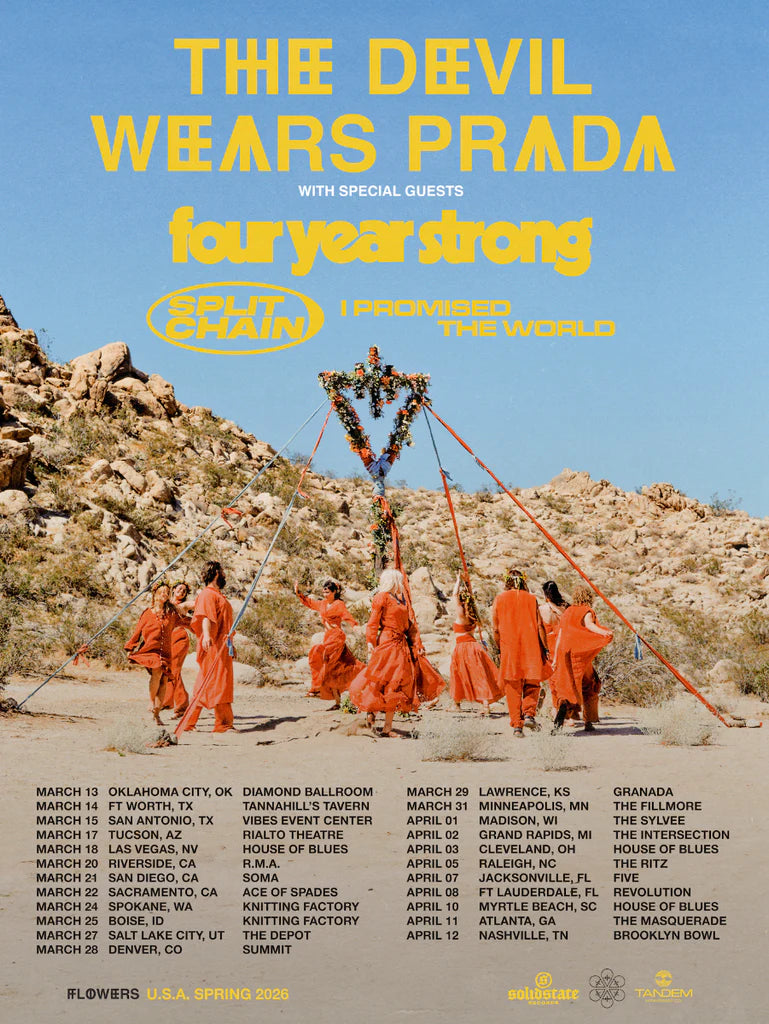
The Devil Wears Prada will head out on spring headlining stretch across the United States in 2026 trekking in support of their ninth full length studio album, Flowers. The monthlong run will touch down in 23-cities across the country boasting a stellar line-up of support with sets from Four Year Strong, Split Chain and I Promised The World.
See the confirmed list of dates and cities for The Devil Wears Prada below. Get tickets - HERE
Flowers, the ninth full length album from The Devil Wears Prada is now available via Solld State Records. Get the album - HERE