

by Maddy Howell / photo by Jonathan Weiner
Since the release of their blazing debut album Descendants back in 2011, Fit For A King have weathered every storm modern metalcore could throw at them. No strangers to navigating chaos – both in the world around them, and within themselves - their career has been forged in faith, fury, and friendship. Balancing blistering heaviness with heartfelt honesty, the Texas metalcore stalwarts have spent over a decade evolving in real time, but they’ve never lost sight of the brotherhood that binds them.
Constantly adapting to the whiplash of an industry in flux, adjusting to lineup changes, and attempting to make sense of the noise, on album eight they’re hitting the reset button. Dialling it back to basics, fuelled by genuine collaboration and a desire to create without compromise, Lonely God finds the band reinvigorated, reconnected, and more creatively unified than ever before.
Built on the input of all five members for the first time, its twelve songs harness their full spectrum of sound: from thunderous deathcore breakdowns and apocalyptic screams to ethereal synths, cinematic strings, and euphoric choruses. Shifting from gut-punching vulnerability to furious catharsis without warning, this is Fit For A King at their most fearless.
KNOTFEST sat down with frontman Ryan Kirby to unpack the creative freedom and collaboration behind Lonely God, and how learning to let go of expectations brought them to their most meaningful album yet.
This feels like a reset moment for the band. Coming into this chapter, what kind of headspace were you in?
RYAN KIRBY - We were talking a lot about where we wanted to go next. Dark Skies did really well and became our biggest record. Then we did The Path, and the goal for that album was to write songs that sounded like they belonged in an arena. That’s why it had this big, anthemic metalcore sound, but it was polarizing. It did well, but it also got a lot of criticism.
Up until that point, our band hadn’t really experienced hate on any real level. So, it hit hard. I guess that’s part of growing. No big band is universally loved, but we weren’t used to it. With The Hell We Create, we kind of overcorrected. We said, ‘Let’s write the safest album of all time. Let’s do nothing that could upset any fans.’ Ultimately, that’s not a great way to make music. We weren’t trying to grow; we were just trying not to upset anyone. It might not have worked for everyone, but at least we were trying new things on The Path. It brought in a lot of new fans and we had more big-name artists reaching out to us than ever before. We realised that pushing yourself can have benefits, even if there’s backlash. We had to step back and recalibrate.
After Dark Skies, the band became a full-time career, and that changes things. When you’ve got a wife and kids, suddenly you’re trying to balance artistic risk with stability. We looked back and realised that Dark Skies was well liked, and we weren’t even trying to make a big record there. We were just writing what we wanted to. We decided to go back to that, because that’s what the fans really want.
Coming into this album, we also had two members – Dan [Gailey, guitar], who’s been in the band for eight years, and Trey [Celaya, drums] for four - who hadn’t been involved in writing before. Not because they didn’t want to be, but because they didn’t want to mess with what was working. They were playing it safe, but they’re both incredibly talented. We told them, ‘Don’t be scared. Just write.’ Trey really ran with that and wrote about 30 songs. Not many made the cut, but the ones that did made a huge impact.
With all of that, this record feels like a huge reset. We slowed down. We stopped worrying about people’s opinions, and we made space for everyone to contribute. We had to reset how we thought about writing and collaboration.
You can definitely hear how collaborative the record is. There are so many different influences and voices in it, but it still feels cohesive. In that sense, it might be the truest record you’ve done to date - everyone’s voice is heard, and each has a noticeable impact. Has that collaboration reenergised you?
Kirby - Definitely. That’s what excites me most. Everyone in the band feels connected to the music now. In the past, it would be a case of two of us having a hand in writing the songs, and then the others just played it. They still enjoyed the crowd’s reaction, but there wasn’t that personal connection if you hadn’t touched it in the studio.
When you’ve been a band as long as you have, there’s a pressure to evolve in a certain way. We won’t name names, but there are certainly plenty of bands guilty of hopping on trends. With this record though, you’ve totally tuned out that outside noise. You don’t get a track like ‘Witness The End’ without adopting a mindset like that…
Kirby - Deathcore with orchestral elements has been my favourite genre for a long time. There are videos on YouTube from when I was 19 where I was playing orchestral death metal. During the pandemic, I even did a collab with Chris [Wiseman] from Currents and Shadow of Intent writing songs in that style. For years though, we told ourselves, ‘That’s not what our band does.’ When you think about it, that statement is silly, because it is our band.
When we were working with Dan Braunstein, the producer of this album, I showed him some of that stuff and he asked, ‘Why haven’t you done this on a Fit For A King record?’ I told him it felt too metal for some reason, but he assured me it was cool and said that the fans might love it.
So, not only did we go for it, but we also doubled down and put our biggest feature ever on it. Chris Motionless absolutely killed it on that track. I think a lot of people see his name and expect some radio-friendly metal with a bit of singing, but this might be the heaviest he’s been in a decade. Why bring in Chris just to do a Motionless In White B-side? We wanted to give him something fresh.
On the other end of the spectrum, you’ve got ‘Shelter’ - a much more personal, vulnerable song. At this point in your career, is it easier to put something like that out there? Or do you still hesitate when it comes to sharing something so real?
Kirby - It gets easier as I get older. When I was younger, I was a lot more self-conscious about showing emotion. Guys are often raised to ‘suck it up,’ but the pandemic gave us all time to reflect. My wife and I adopted kids, they went through therapy, and we did it with them. That helped me learn to verbalize emotion. It’s honestly easier to put it in a song than to talk about it directly. Music becomes therapeutic, as cliché as that sounds.
When we talk about the themes of the record, the title track really stands out. The idea of trading love and connection for power, and the emptiness that comes with that… Where did that inspiration come from?
Kirby - The title track was inspired by American politics and religion. We recorded the album in November, during election season, so that stuff was everywhere. I didn’t want to write just another anti-political album though. That’s been done - and done better - by other artists. I wanted to tell a story and use symbolism.
‘Lonely God’ is the most direct track, but the real story is told through the music videos for ‘Lonely God’, ‘Begin The Sacrifice’, and ‘Witness the End’. It’s about a man with a lot of past demons and regret who gets pulled into a cult, representing politics, religion, activism, whatever. These groups prey on desperate people with good intentions. Often, they’re just being used as a means to an end.
Political groups take young, excited politicians with good intentions and corrupt them over time. Churches want people for money, and to help spread the word, not necessarily to help make the world a better place. They need to keep people dependent, so they talk about hell to scare you into leaving. Activist groups can be just as toxic. People join them for good reasons - wanting to make change, be better - but those systems don’t always have your best interests in mind.
The record explores that, but it’s also about embracing the people around you rather than dwelling on awful things 24/7. It doesn’t mean you shouldn’t fight to change things, but it shouldn’t become your entire life. Here in America, people stop talking to family because of who they voted for. A lot of people actually want the same thing; they just disagree on how to get there. If we looked at the heart of what people are doing, rather than the specific actions, we would see a lot more people getting along.
We have way more in common than what divides us, but often the focus is placed on our differences. It’s about reevaluating what and who you hold closest. When people listen to these songs, what do you hope they walk away with?
Kirby – The people with the most power or success often end up the loneliest, and that’s because of what they had to give up getting there. That doesn’t just apply to bigger scale things like politics and religion, it can be about the smaller things in life too. Maybe you bought that dream car, but now you’re drowning in debt and can’t give your kid what they need. Or you chased a promotion so hard you neglected your friends and family. You finally get the job, but you’ve lost the people around you.
I want people to reflect. Are there people or systems in your life taking advantage of you? Do they really value you? Are they looking out for you? Whether it’s politicians, a church, or even family members… Sometimes you have to ask those hard questions.
Family is one that’s often particularly complicated. There’s that idea that ‘blood is thicker than water’, but if a person is toxic or harmful, it doesn’t matter…
Kirby - Exactly. I think there are a lot of people who could cut out a decent amount of family and be better for it. You didn’t choose to be related to someone, but you can choose who you associate with. If someone treats you poorly, being related doesn’t earn them a free pass.
You’ve been in this game for a long time, and yet the story of Fit For A King keeps growing. It’d be easy to settle into a formula by now, but Lonely God feels like the opposite of that. How do you keep the fire alive?
Kirby - I hate the idea of stagnation. Writing is my favorite part of being in a band, even more than touring. Touring funds the writing for me. Playing shows is how we get the songs to people, but the writing is what I live for. I know some bands write music just to stay on the road, but I tour to be able to write more music. That’s always been my mindset.
Bands are evolving everywhere now too, and that’s so cool. Now, I see a lot of people in their teenage years and early twenties starting bands again, and it feels like it did during the MySpace era. We’re getting older, so we have to stay sharp. If you slow down, ten other bands are ready to pass you. We’ve got to keep moving and innovating.
That’s why The Hell We Create frustrated me. Not because I don’t like the songs, but because we didn’t take any real chances. With The Path, even if people didn’t like it, we tried new things. We pushed boundaries and we asked, ‘What will people tolerate from us?’ Getting back to that mindset - and bringing in Trey and Dan - has helped us expand our sound and our process.
To be at this stage of your career and still feel like you’ve got unfinished business is rare. As a creative, is it empowering to write not because you have to, but because you truly want to?
Kirby - Absolutely. One thing we kept telling ourselves this time was: ‘Let’s give people something they can’t find anywhere else.’ On the last record, there were elements of Killswitch Engage or As I Lay Dying, and The Path had Parkway Drive vibes. That’s fine, but if people like those bands… They can just go and listen to their albums instead.
What worked about Dark Skies was that it sounded like us. If you listen to a song like ‘When Everything Means Nothing’, you can’t find anything that sounds quite like that anywhere else. We wanted to do a whole record of that. We took influence from other artists, sure, but we crafted something distinct. That’s why I love songs like ‘Witness The End’. Where else can you find a deathcore song with a big, hooky chorus like that? We wanted to make Fit For A King the only place to find this particular sound, and I truly believe we did that here.
-----
Lonely God arrives August 1st. Pre-order the album - HERE

Adding to the building excitement surrounding the arrival of Lonely God, Fit For A King have now announced a massive fall headlining tour. The Lonely God Tour will feature Fit For A King leading a 29-date charge across the U.S. and Canada, showcasing new selections from latest studio album along with essentials from their lengthy catalog.
The tour is set to begin October 30th in Phoenix, AZ. and conclude December 7th in Dallas, TX. The run will include stops in Los Angeles, Chicago, Toronto, Montreal, New York, Nashville and Orlando to include a few key markets. In addition, the supporting roster for the Lonely God Tour is massive with Australian metalcore unit Make Them Suffer joining the caravan. Spite and 156/Silence will also bolster the tour, taking on the opening duties for each night of the trek.
See a complete list of dates and cities for The Lonely God Tour below. Get tickets - HERE
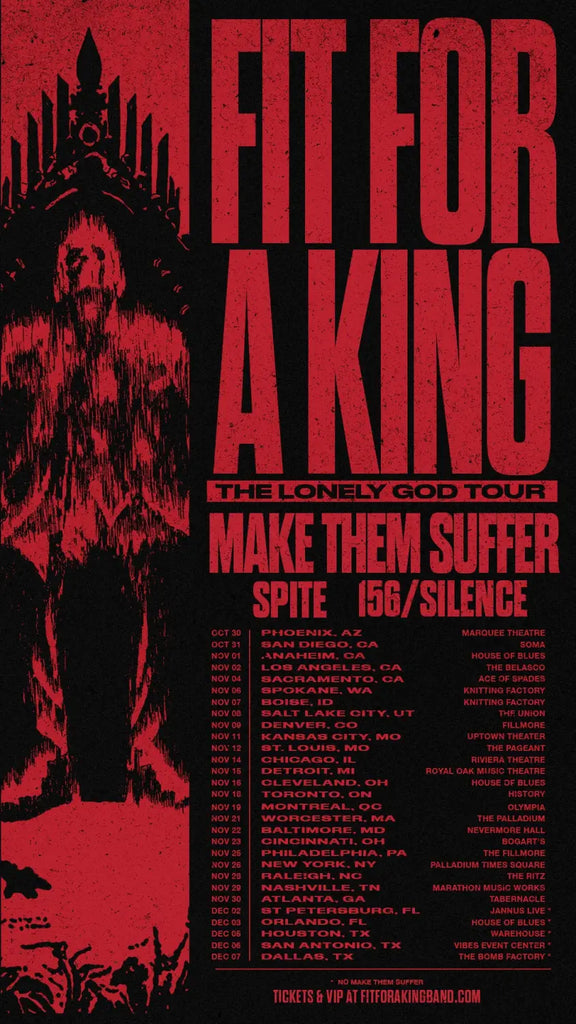
WITH MAKE THEM SUFFER, SPITE, + 156/SILENCE
10/30 — Phoenix, AZ — Marquee Theatre
10/31 — San Diego, CA — Soma
11/1 — Anaheim, CA — House of Blues
11/2 — Los Angeles, CA — The Belasco
11/4 — Sacramento, CA — Ace of Spades
11/6 — Spokane, WA — Knitting Factory
11/7 — Boise, ID — Knitting Factory
11/8 — Salt Lake City, UT — The Union
11/9 — Denver, CO — Fillmore
11/11 — Kansas City, MO — Uptown Theater
11/12 — St. Louis, MO — The Pageant
11/14 — Chicago, IL — Riviera Theatre
11/15 — Detroit, MI — Royal Oak Music Theatre
11/16 — Cleveland, OH — House of Blues
11/18 — Toronto, ON — History
11/19 — Montreal, QC — Olympia
11/21 — Worcester, MA — The Palladium
11/22 — Baltimore, MD — Nevermore Hall
11/23 — Cincinnati, OH — Bogart's
11/25 — Philadelphia, PA — The Fillmore
11/26 — New York, NY — Palladium Times Square
11/28 — Raleigh, NC — The Ritz
11/29 — Nashville, TN — Marathon Music Works
11/30 — Atlanta, GA — Tabernacle
12/2 — St. Petersburg, FL — Jannus Live*
12/3 — Orlando, FL — House of Blues*
12/5 — Houston, TX — Warehouse*
12/6 — San Antonio, TX — Vibes Event Center*
12/7 — Dallas, TX — The Bomb Factory *
*NO MAKE THEM SUFFER


