

2023 was a very busy year for Metalocalypse creator Brendon Small. He released the movie Metalocalypse: Army of the Doomstar, a ringing power chord of a finale to the long-running Adult Swim series. With it came a score album and the crushing Dethalbum IV from its stars, Dethklok. Small promptly embarked on a series of tours which took him and his live band across America, into Europe and over to Australia, alongside Babymetal, DragonForce and others. This spring sees Dethklok embark on The Amonklok Conquest, co-headlining with Amon Amarth and supported by Castle Rat, as well as a handful of their own headlining shows. Metalocalypse might be over, but Dethklok keeps ticking.
This year also sees the twentieth anniversary of the animated series. In Small’s eyes, Dethklok are a bunch of ego-centric, toxic, avaricious capitalists before their time. When he's asked by his fans who his favorite member is, Small reveals that he finds them all selfish and unlikeable. Instead, he empathises with the band's lawyer-manager character Charles Foster Offdensen, who herds Dethklok like cats in the same way Small herds ideas in his brain.
Nathan Explosion (vocals), William Murderface (bass), Skwisgaar Skwigelf (guitar), Toki Wartooth (guitar) and Pickles (drums) are not that likeable, but they've generated their own love amongst Dethklok's fanbase. Touring Army of the Doomstar at conventions, Small discovered that it gave fans a sense of completion after Nathan re-embraced them at the end of the movie. He found the band was the subject of “yumeshipping” culture where some fans wrote themselves into romantic entanglements with different members. At Dethklok’s live shows, the audiences were getting younger, a phenomenon a lot of bands experienced post-pandemic, after they had been discovered by swathes of cooped-up teenagers.
It’s amusing for Small, because Metalocalypse was never meant to be popular. When he originally conceived of the show, it was aimed only at “me when I was 14, discovering heavy metal and discovering guitar.”
“This isn't meant to be broad,” says Small. “This is about extreme metal, death metal, and death and dying. There are all these topics inside of this show that a lot of comedies didn't want to deal with, or were not interested in.”
Small and his collaborators weren’t paid much for their efforts, and the show didn’t cost that much to make, but Adult Swim provided support for its 15-minute weekly slots. Just enough for its viewers to pine for it between episodes.
“I think of TV as being a date, right?” he says. “I want you to be thinking about me all week until we see each other again.”
Small goes further – describing the characters as surrogate friends in a lonely world.
“You get to know the characters so well that when one character walks into the room and he's wearing a stupid shirt, you know what this other guy is going to say about that,” he says. “Because that's my friend, and I know him. That's the part of our brain that gets triggered by this.”
Metalocalypse was born into an America where culture was struggling to re-adjust in the post-9/11 landscape. Small cites how country act The Chicks (formerly The Dixie Chicks) spoke out against President Bush and “got annihilated” as a result. The government was saying one thing about weapons of mass destruction to justify the second Iraq War in 2003, but then there was what Small could see with his own eyes.
Small was disappointed with the lack of heavy music’s response to the heightened political climate of the period.
“Who's speaking out against this stuff?” he remembers thinking. “Green Day, [2004 album] American Idiot, right? And what I also noticed was that metal was getting heavier and getting scary and getting more intense in the early 2000s. So I thought, whether or not they're saying anything, there's a feeling that's roiling underneath.”
Small is right. Metal did become heavier and more agitated in the early 2000s. If a lot of it wasn’t overtly political, it was almost a subconscious response to a world that had been turned upside down.
Television itself fed the Dethklok project. Small used to channel-surf endlessly, trying to find a rock in an ocean of swill to grip onto which reflected his cultural interests. As a result, Metalocalypse became a melting pot for junk TV, and a response to the complacency Small saw growing around him as YouTube emerged in 2005 and exerted its grip. Viewers began to have access to anything they wanted whenever they wanted it.
“So, in a lot of ways, this is heavy metal,” he says of the show. “This is pent-up frustration. This is also a regurgitation of anything that crossed my eyeline in that time through a warped funhouse mirror of throwing it back at you. From anything I saw on basic cable, like the Food Network. Things like that got barfed back out into this pastiche, and that's what the show was really. It was just, basically: I'm seeing stuff and I'm regurgitating it.”
Well that explains the phenomenon that is the “Duncan Hills Coffee Jingle”, for one. For Small, who grew up on a diet of Monty Python and It’s Garry Shandling's Show, he saw a concerning shift away from well-produced and well-written programming to reality TV.
“They were ultimately showing celebrities getting through their day, not knowing what time it is, not knowing what day of the week it is, not knowing how door handles work, or where they're supposed to be next,” says Small. “What if the Kardashians were an extreme metal band?”
He describes putting together each episode of Metalocalypse as sitting on an overstuffed suitcase and trying to close it. There was the added challenge of generating some original music to stick in people’s heads. He ploughed his energy into 2007’s The Dethalbum. Many of its songs dominate Dethklok's live performances to this day, such as “Murmaider”, “Go Into the Water” and “Briefcase Full of Guts”.
The beauty of Dethklok is that they embody a genre that contains multitudes: from the sublime to the ridiculous. There’s a lot of emotion and “glory” (Small's word) in heavy metal. Small also believes there's an uncanny calm in the centre of it. He mentions the quarter-note pulse keeping time in the angular chaos of Meshuggah’s music.
When it comes to bringing Dethklok to the stage, Small counts himself lucky to work with “The Atomic Clock” himself, Gene Hoglan. The legendary Dark Angel drummer ensures Dethklok’s sets remain strong and undeniable in the chaos of balancing the band’s live performance with the visual elements. Small has described the live band (completed by bassist Pete Griffin and guitarist Nili Brosh) as the pit orchestra and the projected visuals of the animated band as the ballet. He doesn’t want the audience’s attention on him in the shadows when Dethklok plays. “I am bad for the brand,” he insists.
But Small has been putting the work in. His vocals have gotten more brutal with better technique in recent years. He has taken guitar lessons from shredder Jason Richardson “to float like a butterfly and sting like a bee” on the fretboard.
“I've definitely learned a lot playing a lot of live music over the last couple years,” says Small. “And in a way, it forced me to take the whole engine apart and clean it and put it back together. I'm old enough to have learned how to do things and forgotten how to do things, and have to learn them a second time: from stand-up to writing to guitar playing. As I'm doing one thing, another thing is atrophying.”
Preparing for a Dethklok tour is not like playing in other bands. Small begins talking to Hoglan months in advance to agree on setlist and visual changes.
“I'm going to give you some stuff that you've never seen us do live before,” he says of the forthcoming tour's setlist. “I'm going to get into some deep cuts that we've never played before. Some of the songs we played last time are not going to be there. We're going to replace them with some songs you haven't heard in a long time, some songs you've never seen us do before, and then we're going to give you some fan favorites that we think we owe to the audience each time.”
Sometimes Small has to commission new animated work and operate at a financial deficit going into a new tour. The Dethklok audience isn’t going to be as forgiving of repeated sequences or looping, hypnotic visuals (as cool as these might be). Each song has to tell its own mini-story.
“I want to hypnotize you,” says Small “I want to tell you a story, and I want you to hand yourself over to us. You know, it's total manipulation, what I'm trying to do. But I think that's what good storytelling is, and I think that's what good directing is, and good acting and good performances. How can I hypnotize you into believing this world exists, which is why I'm in the shadows. I'm in the dark. You shouldn't be looking at me. You shouldn't be considering me. You should be considering the sounds you hear. We sound exactly like Dethklok, but we don't look like them. So I try to keep that mystique alive in our live shows. You can see the source of the music if you want to, but don't be looking at me.”
The upcoming tour with Amon Amarth and Castle Rat sees a triple bill of total theatrical metal. From devouring Iron Maiden VHS tapes in his youth to recently catching King Diamond on tour, Small sees it as a rich tradition which “refreshes” an audience that has taken the trouble to leave the house. Dethklok brings a gigantic TV set into the concert space. From the overwhelming impact of Dethklok writ large to the care taken that a downbeat is synchronised with a particular edit in the visuals, it all adds up.
If 2000s TV culture was formative for Dethklok, so was 1970s rock opera: Norman Jewison’s Jesus Christ Superstar (1973) but particularly Ken Russell’s 1975 film of The Who’s Tommy, which Small adores for melding “abstract visuals” with “concrete storytelling”.
So what does he make of Sphere in Las Vegas? Surely it’s the ultimate venue for a Dethklok takeover?
“I think we could [do it],” Small laughs. “I think we could make people go insane. I think that's something. I think, in the wrong hands, you could really, like, ‘Clockwork Orange’ someone. You can destroy people's minds if you give them the right drug and show them something [mind-blowing]. Great movies are not about the dialogue. It's about action captured on film with great music. And that's cinema, right? So anytime we can do something, even in our crazy, silly, fucked-up, funny world, can we just have visuals and music to captivate an audience? To me, that's exciting, and that's why I love Sphere, because it acknowledges the visual side of music."
As long as Dethklok lives on, who knows whether they might arrive at such a lofty destination. As long as Small wants to keep the Dethklok ticking, anything is possible. But what about Metalocalypse? Was Army of the Doomstar really the final foray? Small admits that the characters are still in his head and “scream out every once in a while”.
“You know, there's a part of me, just because the ending was such a big, heavy thing that makes me want to go: Wouldn't it be fun to have these dipshits in a room just being idiots and being funny and just concentrate on the comedy, the dipshittery?” he says. “All that stuff, to me, is really a fun part of the thing. The ending of this show had to be that big, bombastic thing that still makes as much sense as it did then. But to have funny people in a room hanging out is really a nice elixir as well. And so if I were to ever come back to it, that's what would be the philosophy: how can I just have these people be funny through and through?”
Whatever happens, Small has accomplished his goal of making each platform for Dethklok, from 15-minute TV show to 90-minute concert, work on its own. But for him, touring is the best of all its worlds. It lifts him out of the isolation and boredom of writing and lets him become “a carny”, travelling around and challenging himself to excel as a musician in front of an audience with one of the world’s best drummers at his back. Dethklok live is a kind of “magic trick”, in Small’s words, an exercise in shock and awe leaving audiences “dazed and confused” until Dethklok deigns to set foot in a city again. The problem is that after they are done razing venues to the ground with Amon Amarth this time around, there might not be much of the country left.
-----
Catch Dethklok live this spring on the Amonklok Conquest Tour alongside viking metal horde, Amon Amarth. The tour will include a handful of Dethklok headlining dates. See the complete list of dates and cities below. Get tickets - HERE
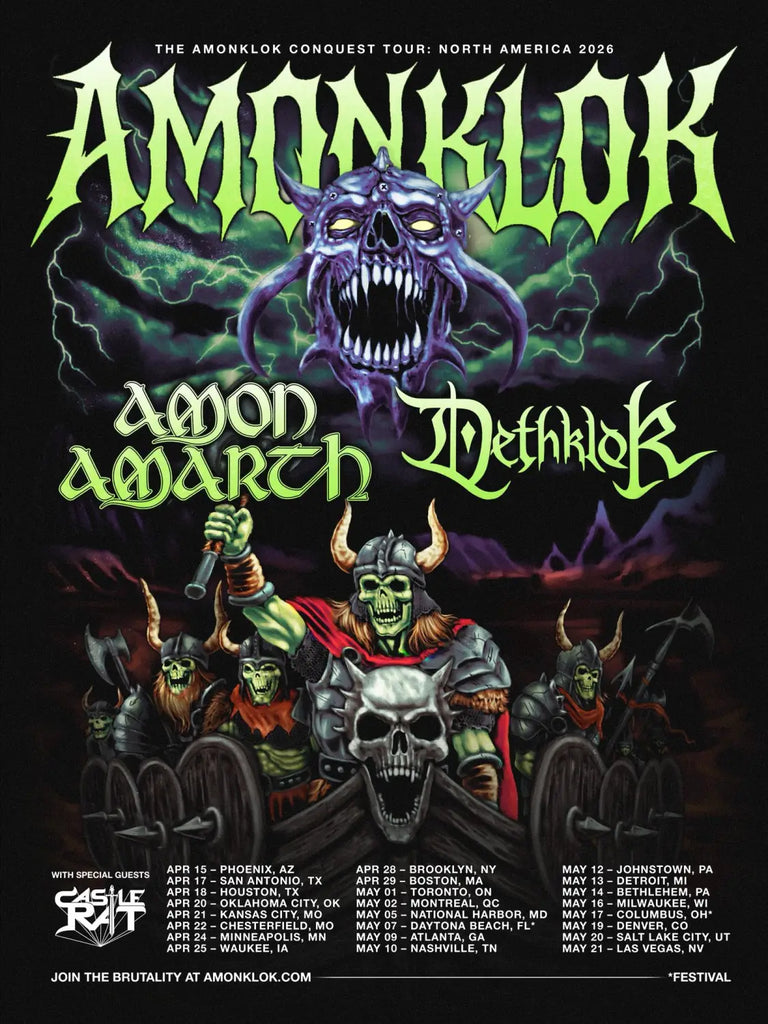
THE AMONKLOK CONQUEST TOUR
Apr 15: Phoenix, AZ - Arizona Financial Theatre
Apr 17: San Antonio, TX - Boeing Center at Tech Port
Apr 18: Houston, TX - 713 Music Hall
Apr 20: Oklahoma City, OK - The Criterion
Apr 21: Kansas City, MO - The Midland Theatre
Apr 22: Chesterfield, MO - The Factory
Apr 24: Minneapolis, MN - The Armory
Apr 25: Waukee, IA - Vibrant Music Hall
Apr 28: Brooklyn, NY - Brooklyn Paramount
Apr 29: Boston, MA - MGM Music Hall At Fenway
May 01: Toronto, ON - Great Canadian Casino Resort
May 02: Montreal, QC - Bell Centre
May 05: National Harbor, MD - The Theater at MGM National Harbor
May 07: Daytona Beach, FL - Welcome To Rockville
May 09: Atlanta, GA - Coca-Cola Roxy
May 10: Nashville, TN - The Pinnacle
May 12: Johnstown, PA - 1st Summit Arena
May 13: Detroit, MI - Fox Theatre
May 14: Bethlehem, PA - Wind Creek Event Center
May 16: Milwaukee, WI - Landmark Credit Union Live
May 17: Columbus, OH - Sonic Temple
May 19: Denver, CO - JUNKYARD
May 20: Salt Lake City, UT - The Union Event Center
May 21: Las Vegas, NV - PH Live at Planet Hollywood Resort & Casino
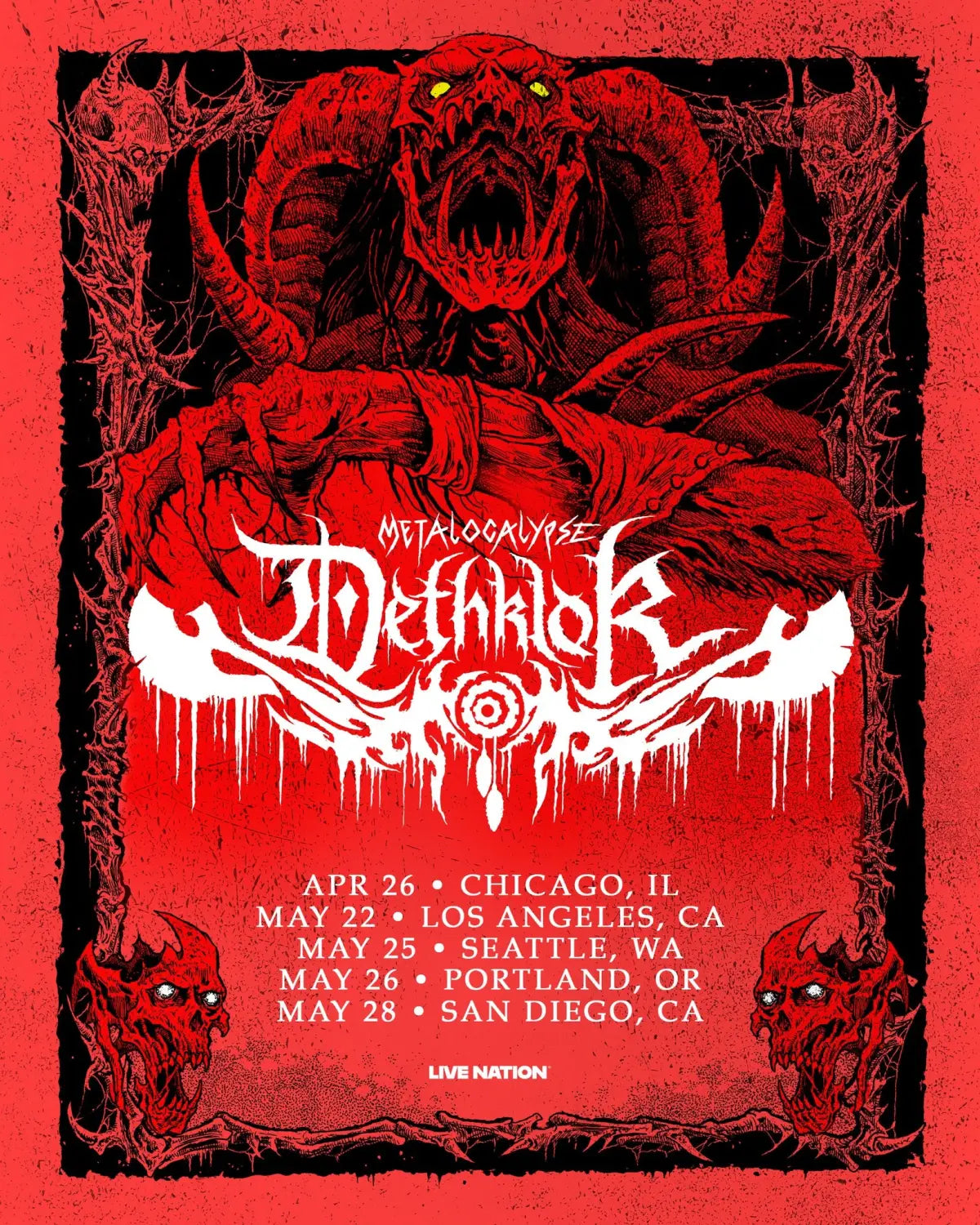
DETHKLOK 2026 SOLO HEADLINE TOUR DATES
Apr 26 – Chicago, IL – Aragon Ballroom
May 22 – Los Angeles, CA – Hollywood Palladium
May 25 – Seattle, WA – Moore Theatre
May 26 – Portland, OR – Roseland Theater
May 28 – San Diego, CA – Observatory North Park


