

Good Luck, Have Fun, Don’t Die opens with a disheveled, wild-eyed Sam Rockwell stumbling into a diner with bombs strapped to his chest and announces that this isn’t a robbery, but it might as well be, what with the bombs and all. The world has already ended, he claims. People just didn’t notice.
Just before that propulsive setup, we’re greeted with a barrage of images: hands scrolling through AI models on glowing phones, first-person shooter games blasting through speakers, and every single face illuminated by the glow of personal screens. Disconnection from the physical and devotion to the digital is what 21st century director Gore Verbinski (The Ring, Pirates of the Caribbean, Rango), in his first film in a decade, is seemingly warning us against. It’s blunt from the jump, and no doubt striking for the most part. Then Rockwell’s “Man from the Future” barrels in, declaring this is his 117th attempt at traveling back to this exact diner in order to recruit the precise mix of strangers needed to save humanity. He’s exhausted and unhinged, for sure, but he also knows everyone’s names, secrets, and supposed futures. He’s grown especially tired of having to convince them he’s not crazy.
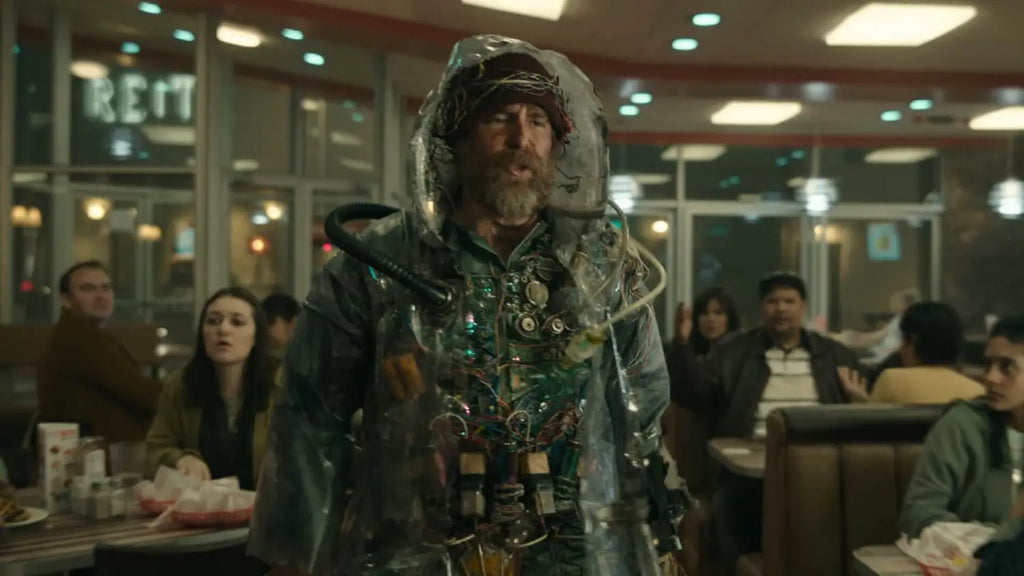
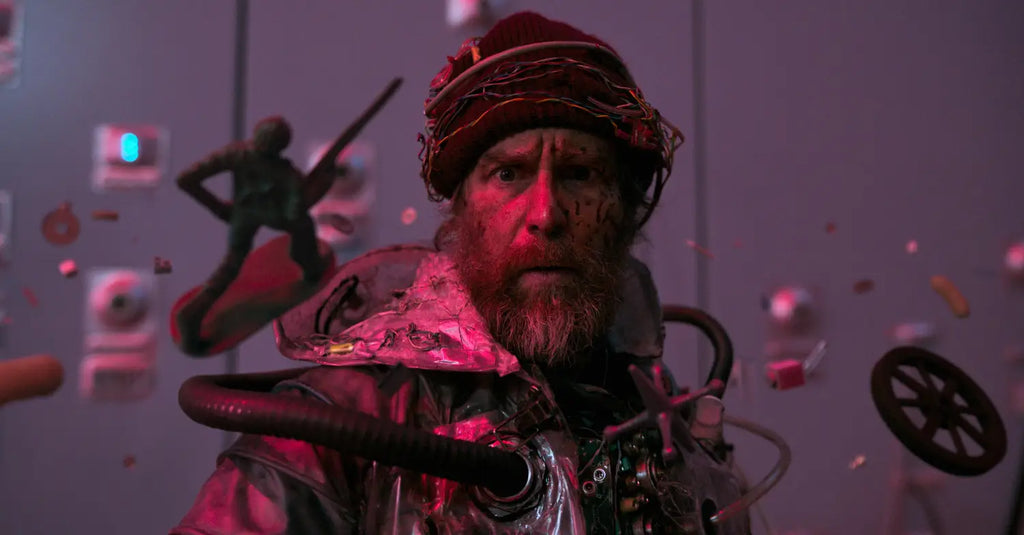
Rockwell (Three Billboards Outside Ebbing, Missouri, The Bad Guys), who is infamous for bringing the heat to any and all projects he’s involved with, is once again on fire here. He makes his act as the nameless Man from the Future all look effortless; manic but controlled, funny yet tragic. He’s the best thing in this movie by a mile, stealing scenes that were already handed to him to begin with. You believe every choice he makes, but what you don’t always believe is the crumbling movie around him that he’s constantly trying to save.
Instead of leaning into the central hook of time-loop desperation, digital paranoia, and a ticking clock, Good Luck, Have Fun, Don’t Die keeps slamming on the brakes for extended flashbacks. We jump backward over and over to explore how AI, automation, social media, and algorithmic living have hollowed out each character’s life. It’s not a terrible idea, but despite the efforts of its ensemble cast that includes Haley Lu Richardson, Juno Temple, Michael Peña, Zazie Beetz, and Asim Chaudhry, this structure feels less like momentum and more like an all-too-familiar series of distracting detours.
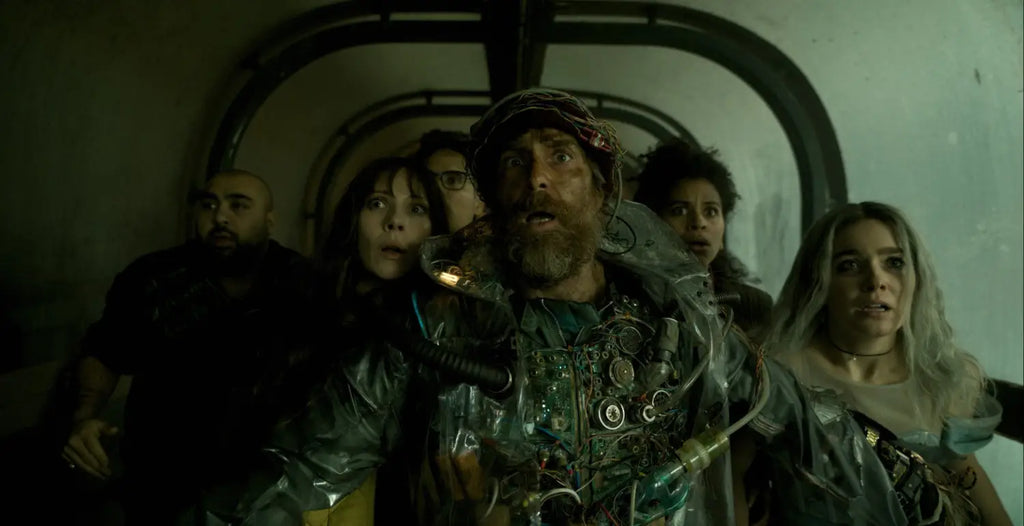
There are some flashes of real bite in these Black Mirror-lite vignettes. Susan’s (Temple) backstory, in particular, lands with genuine force as it bleakly reduces school shootings to commonplace corporate detachment. It’s a brief but dark (and all too real) exploration of how normalized generational trauma has become in the United States, and the film as a whole has an interesting lean towards exploring America’s gun culture. Sadly, that’s not something that lasts (a testament to the film’s overall messiness), but this is when it's channeling a cynicism that actually works.
More often than not, however, the dark snarkiness just doesn't work. Consider how the younger characters are painted almost exclusively as phone-addicted, empathy-deprived robots. There’s a running “phone zombie” bit that never once lands, mostly due to how tired a gag like that comes across even on paper. Ingrid (Richardson), a young woman who is (sigh) literally allergic to Wi-Fi, is the only one given real depth, and even that feels more like a gimmick than a character study. There’s a scene where she’s physically harmed because a kid won’t stop playing a mobile game at a birthday party that’s played so broadly it becomes unintentionally embarrassing.
Verbinski’s latest, written by Matthew Robinson (Love and Monsters) desperately wants to say something urgent about AI, VR, advertising, and all of the digital rot eating away at our current society and humanity in general. But there’s simply nothing here we haven’t already heard, and usually in smarter, more layered ways. The irony of a script decrying corporate brainwashing while forced to casually name-drop Uber, Pepsi, and Disney Princesses, among others, is almost poetic. It’s hard not to feel like the movie itself is trapped in the same commodified ecosystem it’s critiquing.
Structurally, the pacing is the biggest casualty here. The start-stop rhythm kills any sustained tension. Just when the central plot regains traction with deaths beginning to matter and the mission intensifying, we’re yanked back into another dull explanatory aside. By the time the third act rolls around, the film feels exhausted, and worse, predictable. Trope after trope piles up until what began as unique chaotic energy curdles into something wholly mechanical.
Even the score by Geoff Zenelli (Dead Men Tell No Tales), which is genuinely fantastic at first, starts drifting into territory that feels distractingly familiar. There were moments I found myself thinking less about the story and more about which other movie I’d heard that melody in before. It mirrors the script’s larger problem: everything ends up feeling secondhand and derivative, like it was assembled by algorithms mimicking what dystopian satire is supposed to look and sound like.
That’s probably the cruelest irony of all. For a film so loudly condemning the dangers of automation and mechanical thinking, Good Luck, Have Fun, Don’t Die often feels like it was generated by the very forces it’s trying to fight against. The dialogue especially grows more rote as the movie goes, as do the emotional beats and the already weak attempts at humor. By the final stretch, audiences are likely to be more tired than inspired.

There’s definitely a sharper, leaner, and more electric movie buried inside this one. Hopefully it’s a version that trusts its audience more instead of hammering them with obvious points we’ve seen a dozen times over. But this isn’t that. Even with a mostly game cast and a powerhouse lead performance, Verbinski’s long overdue return to the big screen sadly spirals into an overstuffed, tonally scattered cautionary tale that mistakes volume for insight. It starts strong and then slowly, frustratingly, fizzles out.
'Good Luck, Have Fun, Don't Die' is now playing in theaters.


