

There’s an immediate friction at the heart of Night Patrol, one that the film never really smooths over but also never fully collapses under. This latest feature from filmmaker Ryan Prows (V/H/S/94, Lowlife) wants to be a gritty, lived-in Los Angeles cop movie and a savage vampire horror film at the same time, and instead of carefully fusing those two impulses, it largely lets them grind against one another. Sometimes that friction sparks something genuinely electric. Other times, it’s just rough. But even at its most uneven, Night Patrol is far more interesting than it is disposable, and its ambition ultimately becomes its most compelling quality.
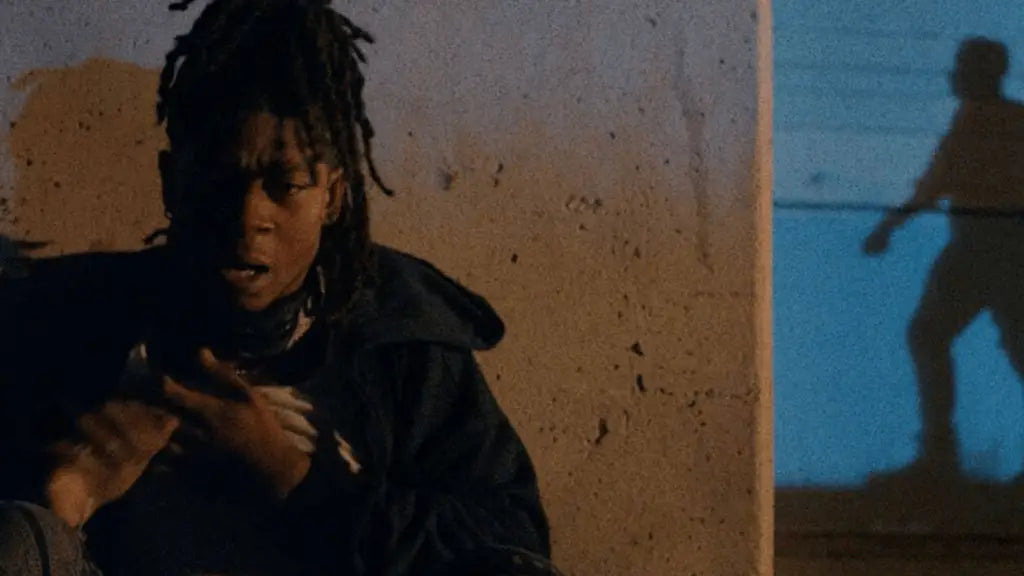
The film opens on a note of blunt, uncomfortable realism: a young Black man (RJ Cyler) in visible agony, wounded and terrified, met not with empathy but suspicion from the state. From there, Night Patrol immediately situates itself in a Los Angeles where policing is omnipresent, invasive, and casually hostile. Innocent people are harassed. Conversations drip with microaggressions and outright racism. The cops at the center of the story who make up the titular patrol don’t feel like heightened movie caricatures so much as painfully recognizable figures, speaking in crude, dismissive language that feels ripped from body cams and cell phone footage. It’s ugly by design, and the film doesn’t ask you to really like these people.
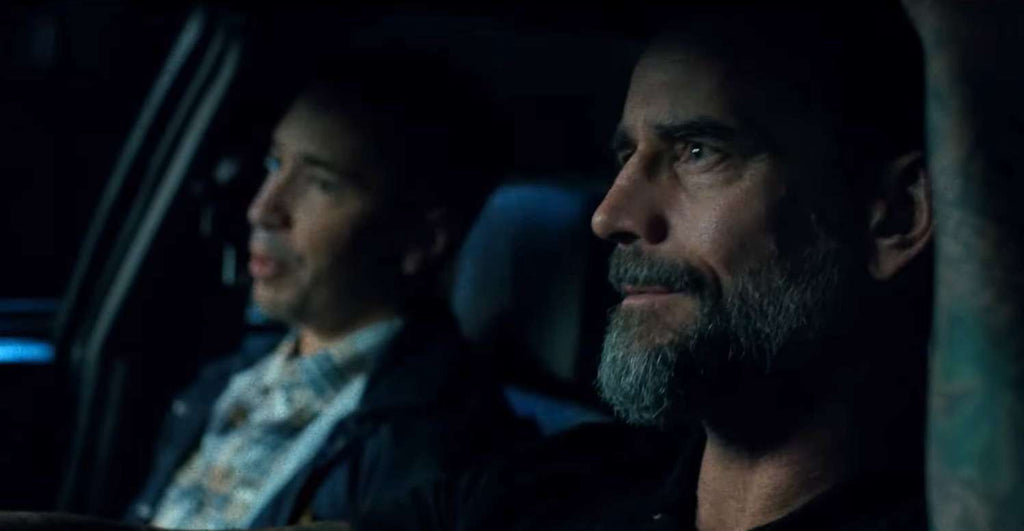
Justin Long’s performance as this gang’s leader is emblematic of the film’s strange balancing act. His portrayal of police brutality and violent bravado is exaggerated to the point of near satire, and while it doesn’t always land with the intended menace, there’s something darkly funny about how transparently hollow the toughness is. Lines like “Don’t do that,” barked at a partner waving a gun at civilians, expose a culture that’s both hyper-violent and completely unserious about accountability. Even moments of mundane downtime, like the cops grabbing lunch at a food truck, are tinged with tension and rot. The movie understands how violence and cruelty coexist with routine.
Visually, Night Patrol is consistently strong. The film captures a genuinely lived-in Los Angeles, one defined by grime, neon glow, shadowy streets, and the uneasy stillness of neighborhoods accustomed to being over-policed. There’s a tactile quality to the environments that grounds the story even when the narrative starts to spiral. The camera lingers on faces, on cracked sidewalks, on patrol cars idling like predators. It’s a city that feels real, and that realism gives weight to the film’s eventual genre shift.
That shift, however, takes its time despite what the film’s marketing is trying to sell. The supernatural element doesn’t fully emerge until well over an hour into the runtime, and that delay is both a blessing and a curse. On one hand, the slow burn allows the film to establish its characters and political and social textures with care. On the other, it makes the structure feel lopsided, as though two different movies are stitched together not quite as smoothly as they could be. When the vampiric Night Patrol finally reveals itself in full, the film explodes into something far more feral and shocking. These are not romantic or seductive monsters. They are ruthless, bloodthirsty killers, xenophobic enforcers who literalize the idea of predatory policing.
Some of the most striking sequences in the film come from this transformation. Random civilians are attacked with terrifying indifference, and the violence is framed not as spectacle but as systemic horror. The Night Patrol doesn’t target based on guilt or innocence, only proximity and vulnerability. In these moments, the film’s metaphor snaps into sharp focus, and the messiness almost feels intentional. This is what unchecked power looks like when stripped of pretense.

The cast is jam packed, with Long leading the pack amongst multi-hyphenates like Jermaine Fowler, Freddie Gibbs, YG, Flying Lotus, CM Punk, and even our very own Hardlore host / musician Colin Young. Nicki Micheaux emerges as a standout amid the chaos, commanding attention whenever she’s on screen and injecting the film with clarity and urgency. Her presence anchors the story emotionally, offering a counterpoint to the cops’ moral emptiness and the film’s more scattered impulses. It’s a performance that suggests what Night Patrol might have been with a tighter focus, but it also elevates what’s already there.
Yes, the film is messy. Its tone veers wildly. Its pacing is uneven. It often struggles to maintain narrative momentum. But there are flashes of genuine brilliance scattered throughout, moments where the film’s anger, horror, and insight briefly align. And to its credit, Night Patrol does circle back to its opening, closing the loop through a police interrogation that reframes what we’ve seen and reinforces the idea that the system will always protect itself first and foremost.
Night Patrol doesn’t fully work, but it absolutely swings for the fences in the right ways. In an era of increasingly safe, sanitized genre filmmaking, there’s something admirable about a movie this raw and confrontational, even when it stumbles. Its flaws are loud, but so is its voice. And sometimes, that’s enough to make the mess worth wading through.
‘Night Patrol’ is now playing in theaters.


