Photo by @bobbycochranphoto
When Jeremy Walker co-founded Fire in the Mountains in 2015, he and two of his other metalhead buddies – Alex Feher and Ollie Tripp – just wanted to see a cool band play in front of the Teton Range.
10 years later, the festival has grown into something beyond his wildest dreams.
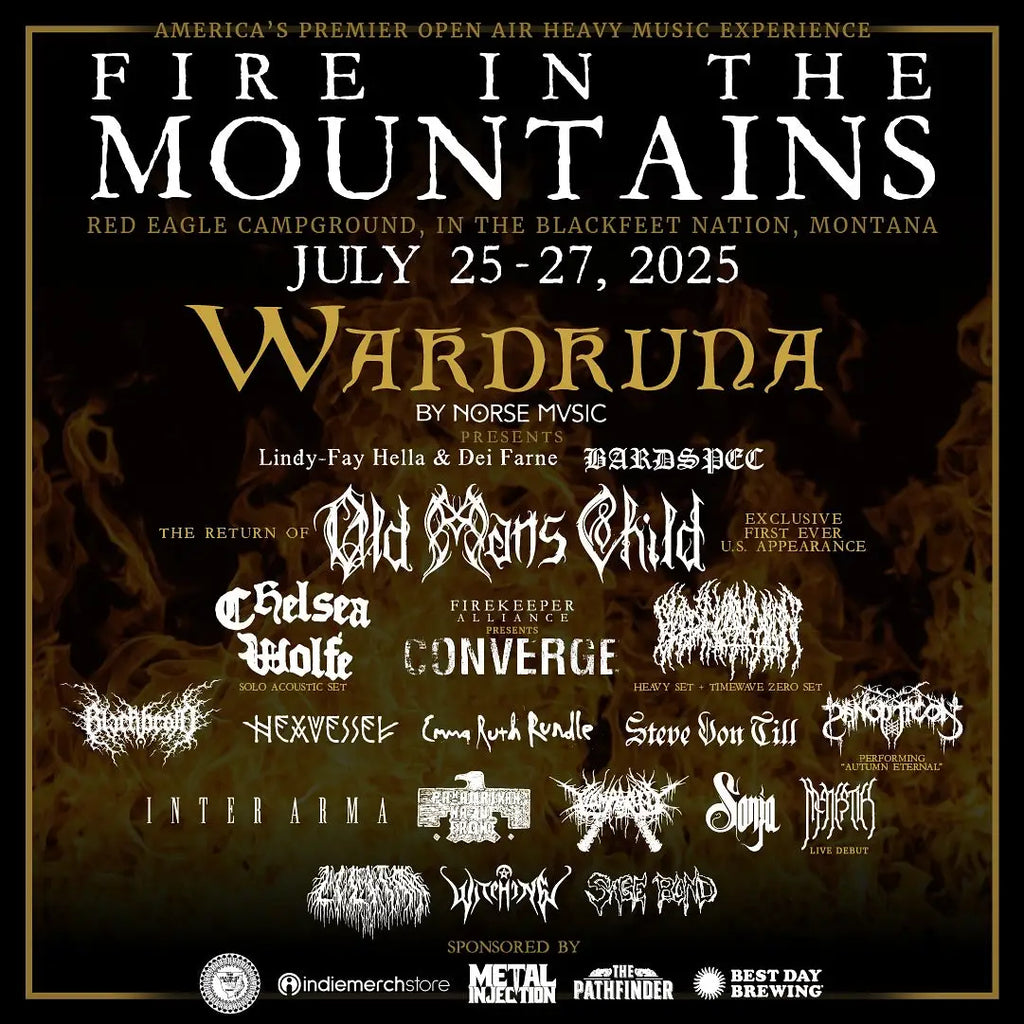
When Fire in the Mountain kicks off from July 25 through July 27, it will have moved from Wyoming to the Blackfeet Nation in Montana, just east of Glacier National Park.
Not only will the likes of Wardruna, Chelsea Wolfe, Converge, Blood Incantation and Old Man’s Child – making their first-ever American appearance – be playing in an open air setting, they’ll be doing so in a support of life, nature, and the ancestral people who are allowing strangers and outsiders to experience their land.
“(Fire in the Mountains) has become something that has been much deeper than I ever thought Fire in the Mountains could or would become,” Walker said. “It’s so much more important than it has been. Not just for the people who buy the tickets for the life changing experiences they’re going to have, but to the community of people here.
“And in particular, really providing something for the youth here to really look forward to and attach to and release energy. They need it. This is for them.”
Montana has the highest suicide rate in the nation, and Indigenous communities are significantly more impacted than the national average. Teens are particularly at risk. The festival aims to “raise awareness about the high rates of suicide in the Blackfeet Nation and all Indigenous communities, in order to bring about better funding for mental health services, more research into effective prevention strategies, and greater overall support for Indigenous health and well-being.”
Walker and his team have worked with the tribal council, locals in Browning, and the Firekeeper’s Alliance to build inroads with the community and show they are serious about leaving the area better than they found it.
“As an outsider coming in and doing this, you cannot do this without their help,” Walker said. “It’s impossible, right? There’s no way. You have to be in, and you have to be invited, and you have to be guided through it. It's really important that we, through the Fire and Mountains endeavors, and through the Fire Keeper Alliance endeavors strengthen this community that has embraced us. That’s the most important thing we can do."
“Maybe music festivals and music organizations should have a little bit more of a responsibility to do good,” Walker said. “Music has a unique power to heal and to create change, and we as people in the music industry need to make sure that we harness that power and utilize it.”
KNOTFEST spoke with Jeremy Walker about Fire in the Mountains’ new home, how the festival has evolved, the challenge of trying to bring it to this remote location, and how this event is going to change people for the better.
Why did you want to start a music festival in the first place?
Jeremy Walker: As many things do in life, this kind of happened by happenstance, in a way. I definitely didn't go into this wanting to create a music festival.
Our first year, which was 10 years ago in the summer of 2015, I co-founded this festival with, Alex [Feher] and Ollie [Tripp]. The three of us were long time friends and metal heads. We were just kind of like, ‘Why don't we book this band Wayfarer and have them play at this secret spot called Shadow Mountain that we know about?’
It was super, super punk rock. It was illegal, you know? The forest service was playing cat and mouse with us. We had to build the stage right up there and then take it apart and throw tarps over it so when the authorities came there was no music.
We started that first year like, ‘Let’s just do this. It’ll be fun and it’ll be badass.’ Then Wayfair got on stage and played with the sun dropping behind the Teton Mountains; in the woods in this amazing location. I was looking around and saw everyone had the same feeling that I did, which was a rush of emotions, this beautiful vista and the way that the music complemented the landscape, (and the) landscape complimented the music. At that point, those of us who created [the festival] together knew very much that we had stumbled on something that we had to run with.
I actually remembered thinking to myself, ‘Well Jeremy, you’re kind of fucked from here on out! You’re going to become obsessed with this thing and this has so much potential, and it’s not going to be easy.’ Especially knowing where I was living, Tenon County, Wyoming. The wealthiest place in the US. I knew it was going to be a big juxtaposition and it was going to have some major hurdles.
So, it’s been a good fucking. [laughs] But it’s been a hard, hard road.
Just about everything you expected, if not more, I imagine?
JW: Yeah, totally. So it grew and people obviously came on board with it. We created the multi-day festival experience in 2018 at Hard Six Ranch. Beautiful, beautiful spot. That’s where we really developed our name and our brand. We had three years there. Obviously COVID gave us some difficulty, and then 2022 was amazing.
But then we got our permits denied due to the ‘not in my backyard’ kind of wealthy landowner attitude. In my opinion, some really, really poor decision making by our leaders. But you know what? When one door closes, a bigger door opens. At that point, that's when some people who live up here on the Blackfeet reservation contacted me and said, 'You should come check out this spot up here.’
My jaw hit the ground when I saw it.
With them, (the festival) has become something that has been much deeper than I ever thought Fire in the Mountains could or would become. It’s so much more important than it has been. Not just for the people who buy the tickets for the life changing experiences they’re going to have, but to the community of people here. And in particular, really providing something for the youth here to really look forward to and attach to and release energy. They need it. This is for them. This is for them.
What have you seen in the lead up to build this festival that has already helped and changed the community for the better?
JW: One of the staples of Fire in the Mountains from the beginning is that this is based around community and building the Fire in the Mountains community. Also, through our business practices, strengthening the community that the festival is in, right? And that's really important too. So being involved here now, with the Blackfeet people and on their amazing, beautiful land, has made it so that community is more important than ever.
The timing for this is actually really good, because people need this in their lives. It doesn't matter where you're from; you can be living here in Browning Montana, or you can be in San Francisco. People need community, no matter where they are. I feel like community is being broken down systematically, either intentionally or unintentionally, but it’s happening.
We’ve been using the term ‘people need to disconnect to reconnect.’ People need to get away. Disconnect. Put your phone down and reconnect with the people around you. This is a great opportunity for the Fire in the Mountains community, that we’ve built over the last 10 years, to do that now.
We’re also going to be able to reconnect with the ancestral people that have occupied this land for tens of thousands of years. I hope that we can connect with them, and they can connect with us, and we can form one unified group over the course of the weekend.
It's really important that we, through the Fire and Mountains endeavors, and through the Fire Keeper Alliance endeavors strengthen this community that has embraced us. That’s the most important thing we can do. I think that we can do that, and I hope that interviews like this set people’s minds in the right place to connect and strengthen the community that’s welcome.
It’s very cool that this community that has been downtrodden for centuries — and very much still is — to welcome strangers onto their land to have a celebration of life in nature.
JW: Well, I will say first that we’ve been welcomed here and invited here because we were brought here. It wasn’t us coming here and saying, ‘Hey, I gotta pitch an idea to you.’
It would be very naive to think that everyone is just all hunky-dory about this thing, too. I think there’s a healthy level of skepticism about what this is and who’s bringing it here, right? As there should be!
Our goal is that after this year, some of that skepticism is defeated and they’re all about it. As long as we can really do a good job organizationally, but then (they) really see that we’re honoring them and their space and their land and their culture. I hope that happens.
But that’s just a good thing to know. There’s always going to be that healthy level of skepticism, and there should be, because of all the historical trauma that has happened.
How would you describe the location, the land, and what you see at the festival grounds to people who haven’t been there before or are coming for the first time?
JW: The thing I am most excited for about this festival is: Right when people start coming into the gates for the first time to go to their campsites, I’m going to stand on the side of the road for about an hour and just watch people’s jaws hit the ground when they get out of their car and they’re about to set up their tent. I already know it’s going to happen, but I just can’t wait to see it. They’re not going to be able to set up their tent for a while because they're just going to be looking around like, ‘Where… oh my God!’
I’m more excited for that than any of the acts. I’m so excited about that because we spent so much time and energy and love and pain and anguish, and all the emotions and tears and blood just setting this thing up and making it happen.
You know, it’s a fun project, but we do this because it’s very rewarding to see people have an experience unlike anything they've ever had. That’ll happen from the moment they drive in and get out of their car for the first time and look around. It’ll set the tone for the whole weekend.
You’ve stated before that Fire in the Mountains isn’t strictly a metal festival. What are you looking for in a band, an artist or an ethos that speaks to what festival is?
JW: From the start of this, we hold ourselves to pretty high ethical standards, and so we generally really want to make sure that the band's content, the group's content, ethics and energy, atmosphere, all of those things kind of represent also what Fire in the Mountains is. This is a totally curated physical experience.
I can’t take credit for booking the bands. Shane McCarthy does that, and he’s done quite an amazing job. There seems to be pretty great consensus out there that the lineup’s pretty awesome, crosses a lot of boundaries and is diverse within our very, very interesting, small, little niche of the music world.
We always want to have this musical experience of peaks and troughs. It's not just the constant high-energy, melt-your-face-off, ear-bleeding metal, right? You're gonna have a musical journey, which is why we like to have soft artists and folk music as well. We like to have some weird country music which I think fits in.
This year there’s going to be quite a lot of Blackfeet music integration involved throughout the weekend that people will experience as well. That’s one of the things: Building the community of this is also introducing the world, showing the world who the Blackfeet and their culture and their art is.
So it’s going to be a really cool experience to have all the incredible acts. I can’t wait to see some of them for the first time and see some of them at Fire in the Mountains for the first time.
When we created Fire in the Mountains, 10 years ago, we actually said, ‘You know what? The end goal of Fire in the Mountains, musically, is to book Wardruna.’ We literally said that, and now we’re doing it.
So I’ll tell you what, a dream come true for me is that. I’ve always wanted to have Wardruna playing in front of the Tetons. That was the idea. I thought it would just blow everything out of the water. Forget Red Rocks, you know? They just played in front of the Tetons.
But now this is even better. Wardruna’s music is very tribal in nature, and they’re going to be playing on Blackfeet land, a sovereign nation. That’s gonna be pretty special.
I know it’s impossible to name every single person that’s helped put this together, but is there anyone you want to directly mention or thank?
This never could have happened without my wife. The fact that she’s still even with me is a miracle. [Laughs] It just shows her patience and her support.
In order to do a project like this, it will have to consume you if it’s going to be successful, right? Otherwise it won’t be. So when you get consumed by something like this — and it's a great thing. It's a great addiction. It's a great thing to be consumed by, right? It's really making a difference and doing something that actually matters. But the support is there. And I’ll tell you, she looks after me.
The people I started this with: Alex Feher and Ollie Tripp. We’ve put countless and countless hours into it. It’s been amazing, but we would not be here without Charlie Speicher, the Firekeeper Alliance executive director. He’s been living here on the reservation for 20 years, and he’s amazing. The Firekeeper Alliance has basically become our partner. Without them, this doesn’t exist.
The other thing is there are a few other people that live here on the reservation — some of them are Blackfeet, some of them are not — that have really, for one reason or another, decided that (they) love this.
Rober Hall has been amazing. Nick Rink. Cinnamon Salway has been incredible. These are people that live here and they believe in what this is and the long term impact that it will have. As an outsider coming in and doing this, you cannot do this without their help. It’s impossible, right? There’s no way. You have to be in, and you have to be invited, and you have to be guided through it.
They have basically been my guidance counselors. Teaching me and teaching everyone else on the Fire in the Mountains crew how we do this. How things operate here, and how you approach doing this. Doing business and the respect and the honor, and taking things a little slower. I’ve learned so much and I’ve grown as a human through that.
But we have an incredible staff, the Fire in the Mountains crew that’s been with us. Shannon Void, who does all of our social media and our marketing, Shane booking and promoting the whole thing.
We ended up hiring this non-metalhead, Ryan Kendall, who is just a wizard when it comes to logistics, operations, and electrical grids. Works Burning Man, Lightning in a Bottle, all these huge festivals. We got him on board. Again, I’ll tell you what, without him, this thing doesn’t operate either.
I just put the puzzle pieces together. They all do the real stuff!
Certainly an operation like this is nothing that can be done with one person.
The population of this festival is smaller than a lot of other festivals that people go to, right? But what makes it really hard is the remoteness of it. So bringing in that infrastructure is really, really hard, and the level of care we have to have for the land is next level. Everyone should always have that level of care at any festival, but we have to no matter what. This is very special land to the Blackfeet people. You gotta respect it.
And, we have to make sure that it’s as clean as a whistle because bears are real. [Laughs] They exist. They are here, and if we’re not clean they get attracted to scents and they’ll come and try and get into your trash and things like that.
So there’s a whole other level of organization and logistics that need to go into based on where it is. So yeah, it does take an army. It takes a community.
What do you hope people take away from Fire in the Mountains when they’re leaving?
JW: I think they’re going to be energized. I think they’re going to feel a level of something in them they hadn't felt before. A level of being alive, connecting to nature, which is literally in our mission statement. Something that makes you feel alive and brings energy back into your soul.
And we need that. We’re so disconnected from nature these days that I hope people that don’t get to be in a place like this very often leave energized.
I think that being a dry festival will make it so people are even more energized. You’re not going to be as hungover as you’d be before. And they go hand-in-hand together. I don’t think people are going to miss the alcohol that much if they do this with the right intent.
And you know… every year we get so many amazing emails and comments about it being just the best weekend of their life. Or ‘I left a different person than I arrived.’ I know it sounds cheesy, but I really hope that’s the case again. Actually, I don’t need to hope, it will be.
I also hope that people really appreciate the journey that it takes to get here, as well as get back home. Take it all in. That's always been one of the concepts of Fire in the Mountains, is that it is in a remote location a little harder to get to.
They’ve got to slow down a little bit and really plan it out, take it in, and have that be part of the whole experience. The journey is part of it, it’s not just the destination.
But the destination is pretty damn sweet.
-----
Fire In the Mountains takes place at Red Eagle Campground at Blackfeet Nation in Montana from July 25th through the 27th. Get complete information - HERE