Written by Perran Helyes
Lamp of Murmuur started in 2019 much like any raw one-person black metal project does. The creative vessel of a musician simply going by M., the project birthed a rapid period of productivity producing several shadowy and enigmatic demos to be put up on Bandcamp and released on limited cassette. It’s not an extraordinary or unique origin story, but the underground buzz that quickly accumulated around Lamp of Murmuur certainly was. Blending an incredibly gifted ability for penning riffs that sing through even the fuzziest recordings with frequent divergences into shockingly danceable goth music often inside the same song, Lamp of Murmuur quickly came to define the burgeoning online movement of raw and vampiric black metal in the early 2020s.
It’s why the shift with 2023’s Saturnian Bloodstorm, his third full-length, felt so shocking, upgrading the fidelity significantly and harkening to a specific strain of turn of the millennium epic Nordic metal typified by bands like Immortal and Satyricon. It was a creative move that paid off, bringing Lamp of Murmuur to an even wider level of notoriety, but it did shed much of the gothic influence that typified his earlier material.
The newest album, The Dreaming Prince In Ecstasy, released in late 2025, is the album this first arc of Lamp of Murmuur has been building to, not only seeing the triumphant return of the band’s goth side but new grander terrains that could only be possible at this stage in its evolution. In one of his rare interviews, M. talks to us about constructing what could be the band’s opus thus far, and the inspirations musical and non-musical that went into its creation.
The raw black metal world is often a very insular, self-contained scene, but Lamp of Murmuur has so far achieved far more breakout success than the majority of bands that start off there. Now that you’re a few years in, how much have you had to accustom to a level of exposure beyond what is regular, and becoming an international touring band?
M - It’s been quite an experience, to say the least. Initially I never expected the project to even play live as a lot of these projects remain studio only entities, but it organically became what it is today, meeting the right people at the right moments and enjoying what we’re doing. We have this collective in LA called Night of the Palemoon with a lot of other projects, related to Blackbraid as well, and it’s this group of people who encouraged me to play this live. We did our first live show in LA at First Street Billiard and six or seven hundred people showed up from all over America just to see that show. I got an offer from a friend in Europe, and the first show of that run was at Roadburn Festival, and it just became what today is a touring band with a stable line-up of musicians. At the same measure I’ve become accustomed to the exposure, where at first the only media that would talk about Lamp of Murmuur would be small fanzines ran by my friends and people I know, and all of a sudden I’m getting features in places like Knotfest, but it’s still the same for me in being a one man operation and the main focus still being the music. I think the latest album is a statement that I don’t care what people expect of this project.
Your previous album Saturnian Bloodstorm was noticeably a radical shift from everything you’d done up to that point. Can you speak to where you found yourself creatively having finished that record and figuring out where the sound would take you next, now that there were these potential different paths for Lamp of Murmuur?
M - The Dreaming Prince was mostly written and recorded almost immediately when Saturnian Bloodstorm came out. I didn’t have time for a lot of those questions as to what I would do next, it just came out, and I think The Dreaming Prince is like an answer to Saturnian Bloodstorm in a lot of ways. That was such a stylistic shift for the project, the audio fidelity has gone up, everything that defined the project in the past was twisted and reshaped. The Dreaming Prince is similar, but at the same time the barebones make sense with all of the elements that have been present since the demos and the first album.
Saturnian Bloodstorm is the album where a lot of this more mainstream attention came from also and I think a lot of people were expecting me to follow the safe route as that Immortal-ish heavy metal that’s sort of easier listening, and The Dreaming Prince I wouldn’t call inaccessible because it’s very melodic but at the same time it has a degree of weirdness and risk-taking that Saturnian Bloodstorm didn’t have. I always talk about Saturnian Bloodstorm as a chapter of own personal life where I was in a lot of turmoil and so I wanted to make something that felt familiar, that was a homage to Dio, Judas Priest, Immortal, Satyricon, all these bands I grew up listening and when you revisit them it’s like feelgood music. Now I’ve evolved from that period of my life where everything seemed to be going wrong, and now I have my feet planted back in reality, I feel reinvigorated and this is what I want to be. It’s a statement of my own ability to reinvent myself from my own traumas and experiences.
The part that was most difficult for me was getting the sound right. I didn’t want to make an industry standard production, I wanted to make something that had identity and didn’t sound like other things going on right now. I was listening to a lot of Hades from Norway alongside different stuff like Curtis Mayfield, Fields of the Nephilim, and Prince, who the title is kind of a nod to and is always an artist I’ve loved, where I’ve used I’m Yours by Prince as my stage into song. That’s why it’s a kind of weird album in terms of sound, where the production is a little muffled on purpose and you’re not always sure if the things that you’re hearing are actually there, in order to create a kind of dream-like state, contrasting with the riffing which is very intense so it has one foot planted in the waking world and the oneiric dream world.
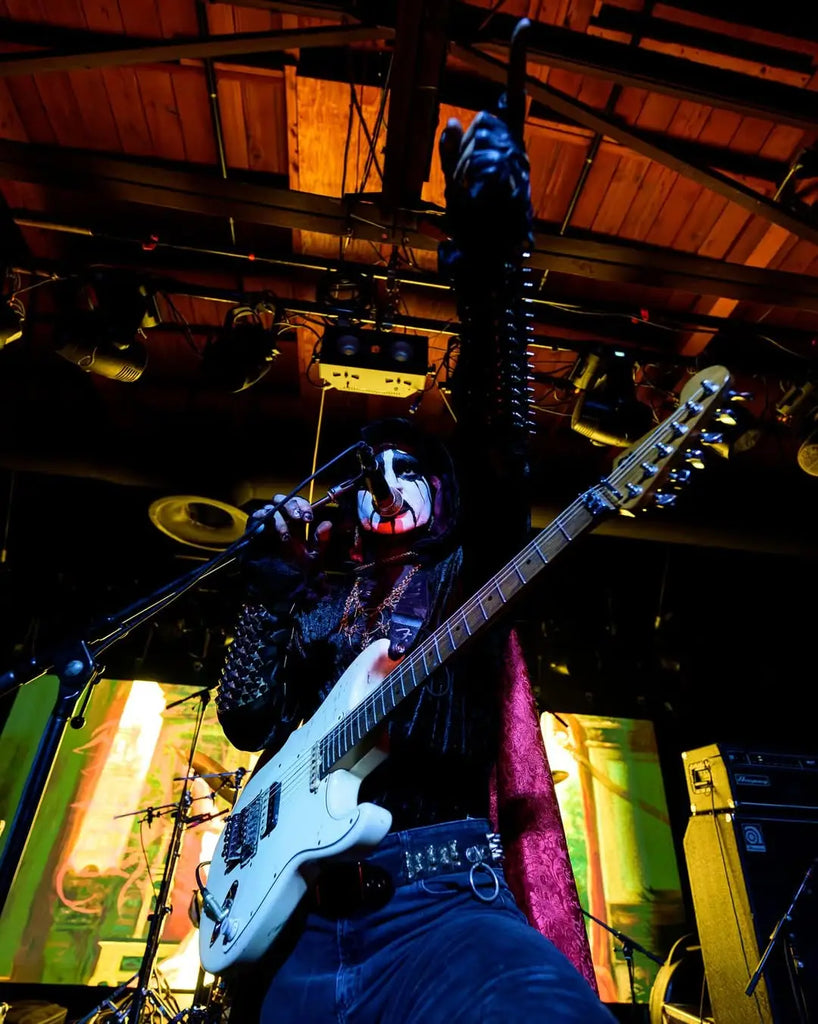
Photo by Maurice Nunez
Where you spoke about Saturnian Bloodstorm being an album with this feeling of triumph and affirmation more in line with classic heavy metal, where is that feeling sitting for you now you have an album that has shades both of that and the more nightmarish goth element having returned alongside it?
M - Those triumphant elements are still in the sound, but it comes with an acceptance of who I am and how I see myself. It’s still growing and changes its shape so constantly, and existence itself is full of these dynamics and the wide array of emotions you experience.
Saturnian Bloodstorm was like a reaffirmation that I was recording this album despite what was going on. I lost much of my ability to play drums because of this unbearable physical pain that I had, and so I had to program them, and the album still managed to come out strong. That was the sentiment of Saturnian Bloodstorm, I fucking did it, even when all the odds were against me. With The Dreaming Prince it’s a little more arrogant, having done that. I’ve seen what I can do when put through this, and now that I’m comfortable, I can be daring and dare to explore these things beyond my comfort zone.
It's an audaciously structured album where on Side A you have these already quite densely structured individual songs, but then Side B with the three-part title track is the biggest thing you’ve yet attempted. Did you feel like when the seeds were being planted for that that it was going to be the big one?
M - Pt. III - The Fall was actually the first track that came to me, out of pure chance. I was walking with Georgios [Maxouris] from Dödsrit and all of a sudden I got hit by this feeling and I remember saying to him, “I need to return to your place, because there’s something in my head that I need to put into reality”. I rush back to his place, and The Fall comes out in one sitting. From there it grew into this three-part suite, and I was recording some of the parts like Twilight Orgasm second guessing myself if this even still sounded like a Lamp of Murmuur album. It’s not really black metal, it’s like a Killing Joke or Fields of the Nephilim goth song, but it felt like it was coming from the same place so yes, it’s a Lamp of Murmuur song. When I finished Pt. I - Moondance I noticed it was starting in a similar way to The Fall, and so realised that these three parts were actually one thing. I’ve always enjoyed bands like Yes or Genesis who have songs that are twenty minutes long, and I liked the idea of making a song like that that would be the statement for the record.
The way that song in particular brings together the classic goth and the black metal, it feels very much like black metal and goth music is part of the same spiritual goal for you with the music. What do you feel that the kinship between the two genres is for you that draws you to blurring that line?
M - I think it’s mostly exploring dark aspects of the human psyche, and this nostalgic atmosphere, especially in bands like Dead Can Dance or Die Verbannten Kinder Evas who pursue this neoclassical darkwave sound and they have this feeling of being from another time and place. That’s kinda what I feel from black metal a lot as well. It’s something that doesn’t feel like it’s from this age, it’s a relic from times past and is from an era of existence that feels very distant, and that’s the kinship that I feel. They so perfectly express this feeling of distance and being out of time. When I’m in Europe and I’m walking through some of the landscapes that the continent has to offer, or in Cologne one of the biggest gothic cathedrals and you’re walking through these giant halls imagining the people that may have walked through these halls several centuries ago, that’s the feeling that I get from black metal as well as goth music.
I know a lot of people like to see black metal as this isolated thing that shouldn’t merge with other things, but the more I interact with people who are active in the scene making actually interesting stuff, it’s people that come from many different backgrounds. When you look back at the 90s which is mostly my main source of inspiration writing black metal, you had all these projects that are considered like essential listening and they were doing all kinds of weird experiments within the genre.
You had bands like Gehenna with the organs, you had Ulver for fuck’s sake! Dodheimsgard, Mysticum, Arcturus, or some of the hidden Eastern European stuff like Ha Lela or Poccolus, no one would dare say these bands are fake black metal. A lot of people have this weird contradiction and the reason why the 90s were so great is there was this curiosity and ingenuity to do whatever you want with the genre, and see what it could become. Of course there were hit and miss albums but at the same time I love listening to some of the albums from the late 90s or 2000s that are shunned by black metal purists, like Volcano by Satyricon or the weirder Arcturus albums that have rapping or whatever, it’s interesting to listen to! I think the most interesting projects going on right now are ones that are bending the rules a little bit.
The final track A Brute Angel’s Sorrow which is where the album really steps into that gothic neofolk world features vocalists from Kekth Arakh and also Frank Iero of My Chemical Romance. How interesting a relationship was to to come about?
M - I think that was a fun statement in itself, having someone like Frank doing vocals on this album. I’m a relatively young person, I’m 30 years old, and I grew up when music like My Chemical Romance was dominating alternative music before I got very deeply into metal. I remember listening to the first My Chemical Romance album and I still think that’s a great album. That song in particular is interesting because it’s the only one that was written even before Saturnian Bloodstorm, and I found it again when making The Dreaming Prince In Ecstasy and it seemed to encapsulate it perfectly. There’s a lyric “Our passions have led us from nothingness to glory”, and that’s kinda the statement of the album I want to make.
This is a project I expected nothing from and it has led me to some of the wildest places I’ve ever been to. I’ve been making music for fifteen years and nothing I’ve ever done has had the level of relevance that Lamp of Murmuur has had. I’m very grateful for it, and I’m going to be proud of it. It’s an arrogant album and is very unapologetic, it does what it wants in the way it wants.
It was incredible when Devil Master supported My Chemical Romance, they’re good friends of mine and I was so happy when I saw that, and it’s crazy to think how these lines between the underground and the mainstream have been blurring more and more. It’s very usual to see a high profile celebrity supporting underground bands, I think a lot of it is to do with the internet and how accessible everything is right now, but publically taking a band on tour with you like that is another level altogether. I’m very grateful to bands who have this kind of platform to offer for underground smaller bands, because there is a vacuum in music between the bands who play stadiums and then the real underground. I think it’s healthy for music itself to have these bridges being built.
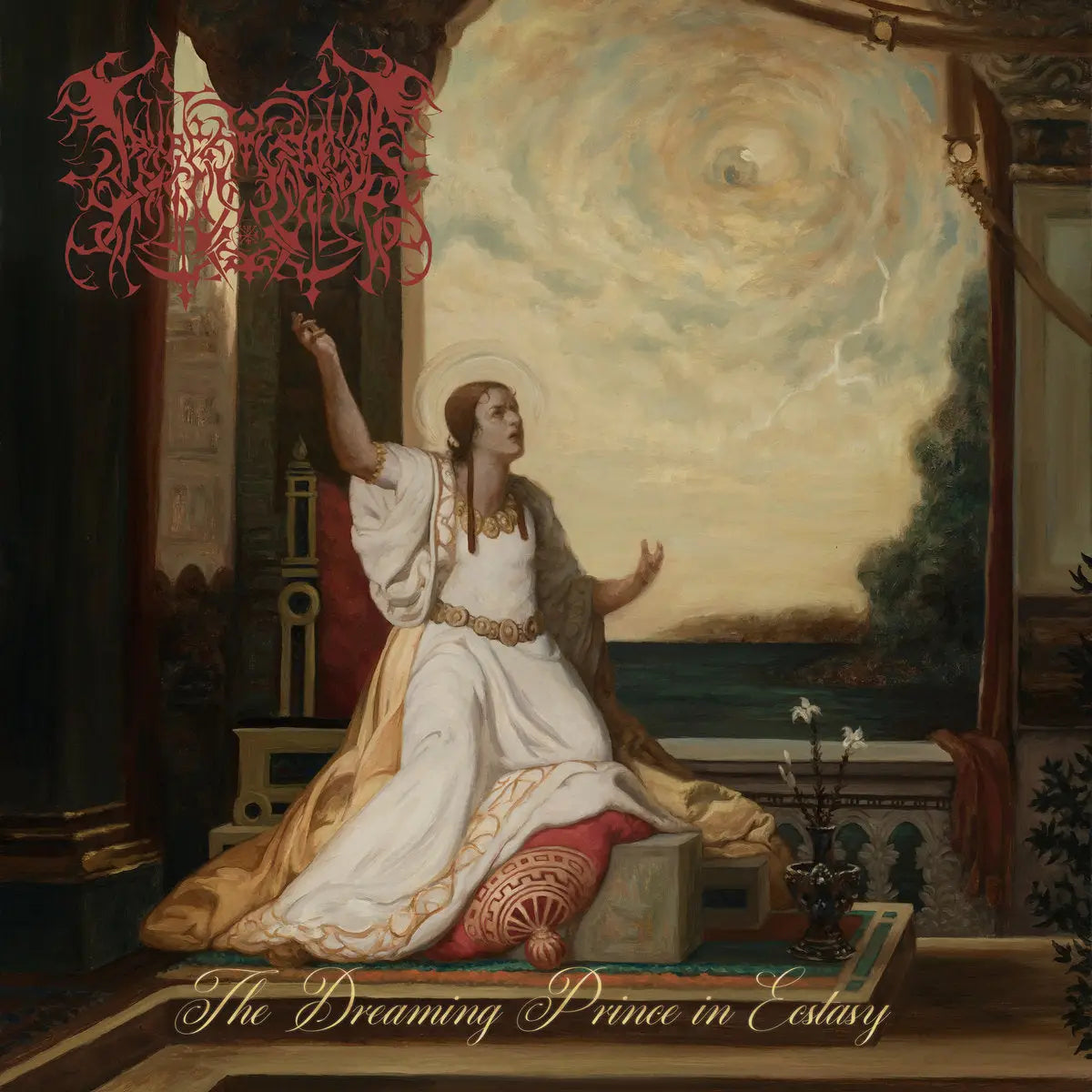
The artwork looks like it could be an existing classical piece but it’s an original, correct?
M - It’s a piece commissioned for the American artist Batdog, who has done stuff for Antichrist Siege Machine and Dodsrit, and it’s inspired by the Symbolist painter Gustave Moreau, loosely inspired by The Dream Haunting the Mogul. I receive a lot of inspiration from stuff outside of music, specifically paintings I really love and what we talked about with them relating to black metal and gothic music somehow feeling like they’re from another time and place, and I saw this piece and was immediately enchanted by it. That’s why I asked Batdog for an interpretation of it and it has that feeling of the album where the boundary between nightmare and reality is blurred and nonexistent.
We’ve mentioned several other bands here you’ve come up alongside and it feels like there’s a really strong sense of scene and community there. Considering the often inherently solitary nature of how a one-man black metal project like Lamp of Murmuur tends to come about, how fulfilling has that been to watch develop?
M - It’s something that I’m actually very proud of, being able to tour with incredible musicians and people who make stuff that I listen to in my daily life. I’ve always been kind of isolated from the world, and in the last couple of years I’ve managed to link up with these incredible people that I can call my friends, people like Jon from Blackbraid or the guys from Devil Master or Dödsrit. I think bands like Blackbraid are necessary where this is an independent artist managing to play some of the biggest stages in our world, and it’s very inspirational to do stuff with people who are always raising the bar.
We push each other to become better musicians, to up our stage presence and the presentation of the project, because there’s commitment to this community we’ve built. I know this is a word people don’t associate with black metal, but it’s fun! You read the books about black metal bands in the 90s like Emperor or Immortal or Cradle of Filth touring together, these legendary stories that kind of thread the line between fantasy and reality, and I like to think that we’re creating something that will endure the existence of the projects themselves.
-----
The Dreaming Prince in Ecstasy, the new album from Lamp of Murmuur is now available. Get the album - HERE