

Photo by Matthieu Gill
When Conjurer’s Dani Nightingale initially pitched co-vocalist and guitarist Brady Deeprose to open their new album with a reworking of a century-old gospel song called “This World Is Not My Home”, Deeprose wasn’t convinced. Nightingale had first heard it playing in the background of a video by YouTuber Jacob Geller. That version of the song, performed by Ben Babbitt, haunted them. As Conjurer began to delve into the thematic heart of Conjurer’s third album, Unself, it seemed to address exactly what they needed it to.
The original intention of the song was to convey how the world is a stepping stone to where we all supposedly belong: God’s embrace. But to Nightingale, it described a state of being out of alignment with, and spurned by, wider society. When Nightingale stepped into the vocal booth to sing it during preproduction – in a delicate, plaintive tone, rather than their habitual guttural roar – Deeprose was floored. That take is the first thing you hear on the album.
“It just absolutely hit us like a ton of bricks,” Deeprose remembers about listening to the performance alongside producer Joe Clayton. “The emotion in their voice, it conveyed everything that we wanted it to convey. And it has really become the spine of the record, the through line of: here are all of the things about the world and society and modern life that Dani specifically feels contribute to them not feeling like they belong.”
On “Unself”, the titular opening track where “The World Is Not My Home” is transformed, the folk chords, voicing and acoustic guitar soon cave into a gargantuan wave of distortion. Deeprose’s high-pitched scream blends into Nightingale’s roar. The album as a whole is an expression of Nightingale’s pain, after an autism diagnosis in 2021 revealed why they were struggling to feel comfortable in their own skin, and the accompanying realisation that they were non-binary.
Conjurer's previous album, 2022’s Páthos, was a “maximalist” album (Deeprose’s word). Its recording was also fraught. He remembers hurrying to write the lyrics and track the vocals of the song “Basilisk” until 2am on their final day booked in the studio. The last album to feature drummer Jan Krause, it delved into Conjurer’s interest in the avant-metal fringes of the Roadburn Festival scene. Whereas their debut full-length, 2018’s Mire, took its cues from Mastodon, Gojira and Converge – “exciting post-metalcore music,” smiles Deeprose – the idea on Páthos was to drop the needle anywhere on the record and have something interesting going on.
This gave it an overbearing, impenetrable feel at points. It sacrificed some of the brutality and immediacy of Mire’s fantastic riff-driven sound, for something more cerebral and rhythmically driven. It was still mercilessly heavy. And Unself feels like it couldn’t have been written without the musical and emotional bedrock laid down on Páthos.
“Some of my favorite Conjurer riffs are on Páthos, but they are so mired, ironically, within so much other material.” Deeprose smiles at the pun. “There's so much going on in those songs to the point where they're not my favorite things to play live, because a lot of the time you've got to stand stock still and look at your fretboard and really focus on the technicality of what you're playing.”
Páthos pushed the band in different directions, including introducing clean singing on “All You Will Remember”, and giving them a broader sonic palette to paint with. That album was about achieving perfection, but now Conjurer are much more concerned about expressing themselves as clearly as possible. For Deeprose, that means being “intentional” about the material and letting ideas breathe. If you listen to the opening guitar of “There Is No Warmth” and maybe hear a shade of Korn’s “Counting” from 1999’s Issues, it’s because the band wants to have a good time, even if a lot of the album's material can appear ostensibly miserable.
“If you can maybe sacrifice 5% of the quality of a riff to make it 50% more fun to play, or make it feel good, that is at this point worth it for us,” says Deeprose. “Because I want to be playing these songs for the next however many years, and I don't want to get sick of them.”
After Krause’s exit and Noah See joining on the drums, See asked Nightingale, Deeprose and bassist Conor Marshall to let him have it. They opened the riff vault and laid down a huge number of scratch ideas with him, so See could get the feel of the material. The band went into Unself prepared and, most importantly, open to what might come out of themselves. When Deeprose sent the masters to Krause for his feedback, the ex-drummer wrote back that he was “clearly not the target market”.
“It feels like if he had stayed in the band, there would have been this internal struggle between what he wanted the band to be and where the rest of us were at,” says Deeprose.
Where Conjurer is at on Unself is the centre of a brutal melange of black metal, doom metal, and post-metal (and yes, a pinch of slab-heavy nu metal). Conjurer have long referred to themselves as “UK riff music” and it is as simple as that: one straight (sub)genre approach would be a highway to boredom. What has changed is their method. Before, they would write via electronic means: group chats, emails and Guitar Pro software. In Deeprose’s eyes, this means that “a song has been born and died before you’ve even recorded it.”
Not so with this album, where the emotional and musical authenticity of the experience demanded to be locked together. The band needed to see the whites of each other’s eyes and communicate their hopes and fears directly. The de-coupling from one's self is both traumatic and liberating. For Deeprose, it meant removing biases and uncovering the veil that has previously cloaked their “verbose”, often archaic lyrics. They haven’t changed their approach to lyric writing entirely, but have turned their target outwards. “The fortune of others but a squandered yield/That slipped your calloused grip,” as it goes in “Hang Them In Your Head”.
“We are finally willing to be more emotionally vulnerable and authentically try to reach out and connect with people on this album,” says Deeprose.
There’s the bursting out of pent-up fury on “All Apart”, conveying the hypocrisy of schoolteachers urging children to express themselves and love themselves, as long as they fit a certain mould. That song is anchored in the growing pains of all the band members, but “Let Us Live” is directly about Nightingale’s experiences as a non-binary person. The song takes Conjurer into new places. They would not/could not have attempted the intimacy of its introduction or scope of its chorus before now.
“It is specifically about the continual marginalization of trans people in this country, and how that is absolutely abhorrent,” says Deeprose.
The searing questions at its centre are both complaint and plea for understanding: "Is it my skin? Is it my lover?/Is it my body and all that it’s suffered?/Is it the way I just want to be seen?/Is it my life you want taken from me?"
Strongly linked to “Let Us Live” is the instrumental “A Plea”, featuring a sample of Spanish trans politician Carla Antonelli. The band reached out to her to ask if they could excerpt some of a speech she gave: “Aren’t you ashamed of yourselves?” she demands in the sample. “You want to remove, eliminate, cut off from this society a group of historically persecuted people who are keeping their heads high, who are trying to occupy a place in this society.”
Antonelli recently had dinner with the band, chatting politics via translation apps, following their appearance at Spain’s Inkestas Fest. Part of the left-wing Más Madrid party, Conjurer sympathises with Antonelli’s views. If Unself is part harrowing dismantling of the ego and wrenching a new identity into the sunlight, it is also a pounding evisceration of capitalism and how the system of money enslaves those who seek to control it: “What twisted game is this/When you’re serf to that which serves you?” (“The Searing Glow”) If the gaze of society can make us feel unwanted, we are also entitled to stare back.
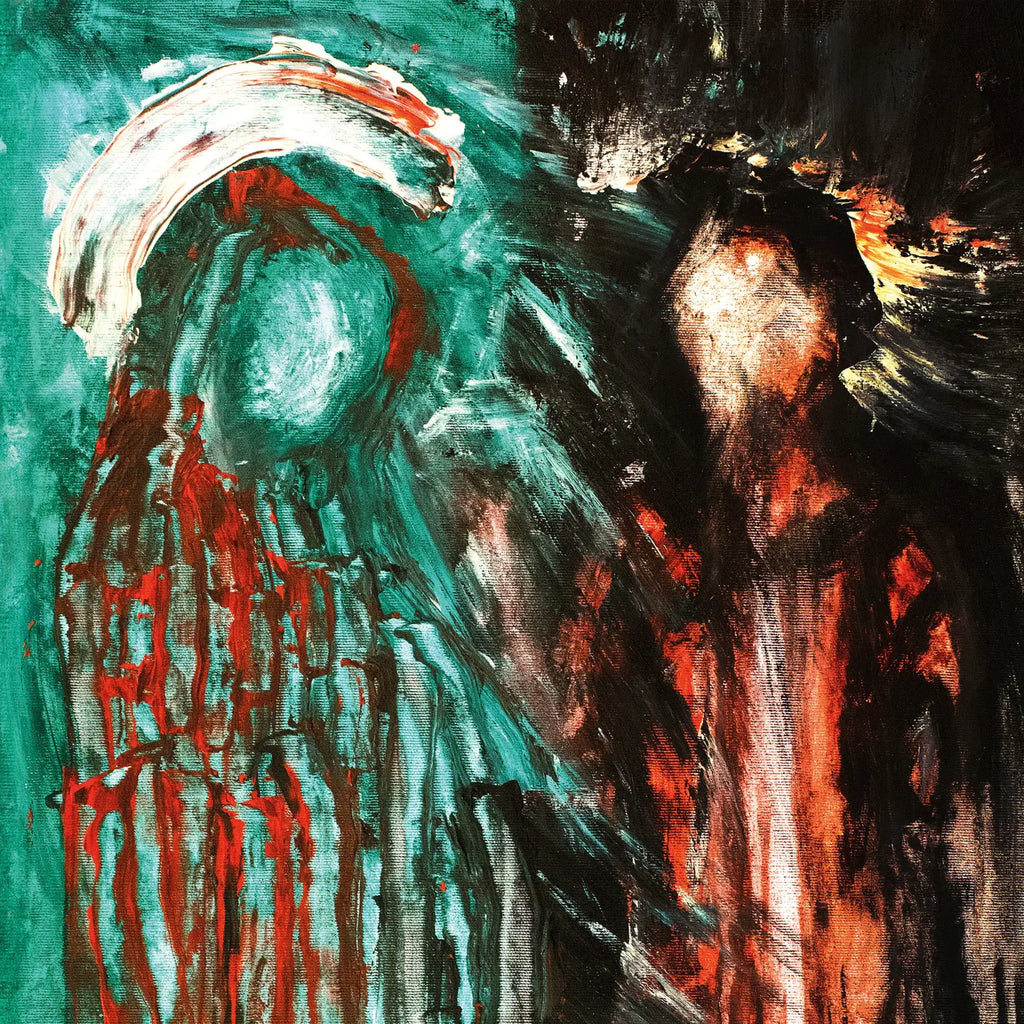
Conjurer has changed. Deeprose speaks admiringly of albums by Gojira and Mastodon: how they feel like records, as opposed to mere recordings. With Unself, and its arresting, unsettled album cover painting by Joost Vervoort, Conjurer have crafted an album that is as complete a representation of their potential as much it is a reckoning with the core of their characters.
“I have so much patience and empathy for who Dani is,” says Deeprose. “Because of their own understanding and self-actualization, and their ability to now actually know what they need and how they can be accommodated. Everything about the dynamic within the band has changed and got better. They are so much happier touring now. Every single part of what we do together has improved.”
When Deeprose speaks about the journey they have been on – from young kids from the north of England wanting to be in a metal band, to adults who have toured with Carcass, Obituary and Clipping seeking to express themselves in a hostile world – he beams with love. Acceptance, of oneself and one another, is hard earned and hard won. Make no mistake, Conjurer are still heavy as fuck, if not heavier than they’ve ever been. But isn’t love the heaviest emotion of all?
-----
Unself, the third full length album from Conjurer arrives October 24th via Nuclear Blast Records. Order the album - HERE
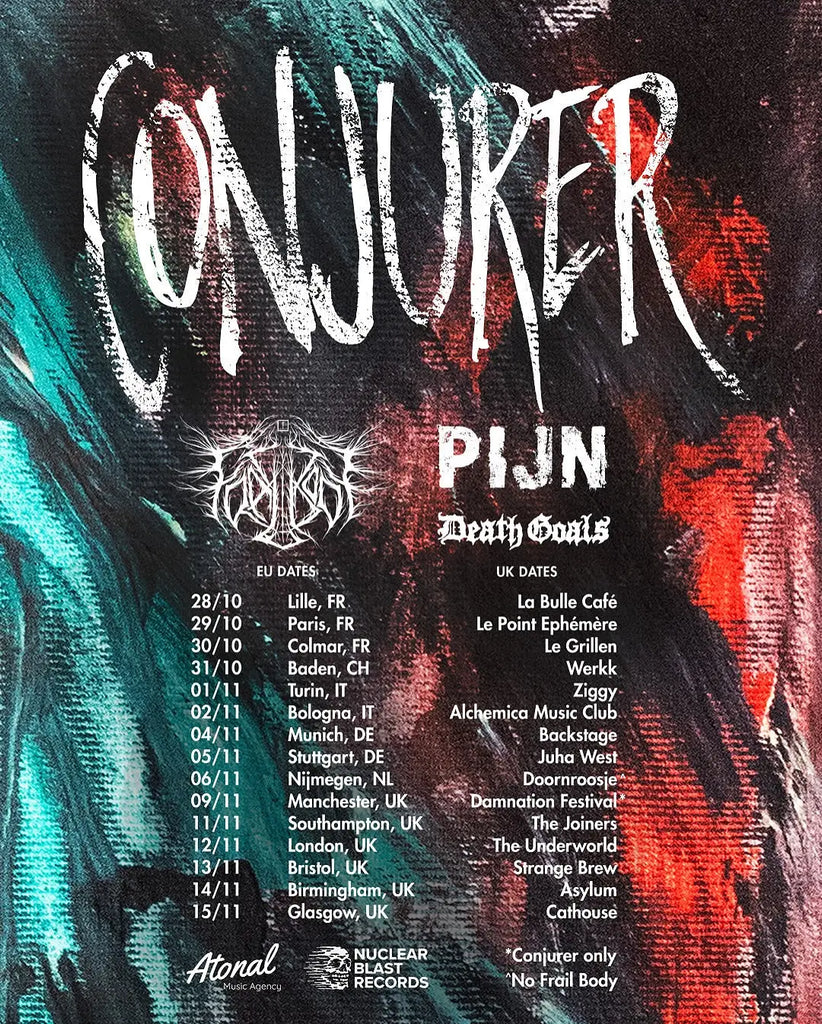
29.10. FR Paris – Le Point Ephémère
30.10. FR Colmar – Le Grillen
01.11. IT Turin – Ziggy
02.11. IT Bologna – Alchemica Music Club
04.11. DE Munich – Backstage
05.11. DE Stuttgart – Juha West
06.11. NL Nijmegen - Doornroosje
09.11. UK Manchester – Damnation Festival
11.11. UK Southampton – The Joiners
12.11. UK London – The Underworld
13.11. UK Bristol – Strange Brew
14.11. UK Birmingham – ASylum
15.11. UK Glasgow - Cathouse


