

Creature features have always functioned as a kind of cinematic Rorschach test. Sometimes the monster is just a monster, some big thing with teeth designed to chew through disposable and / or detestable characters. Other times, the creature is the whole point, a reflection of human cruelty, hubris, or negligence turned back on us with interest. This month’s one-two punch of Primate and Killer Whale sits squarely at that crossroads, offering two very different flavors of animal attack horror built on similar foundations.
Neither film is exactly a classic, and neither fully sticks the landing to various degrees. But taken together, they make for a fascinating snapshot of where modern creature features are at, or perhaps where they’re just forever destined to be: torn between empty carnage and something closer to ecological or ethical horror.
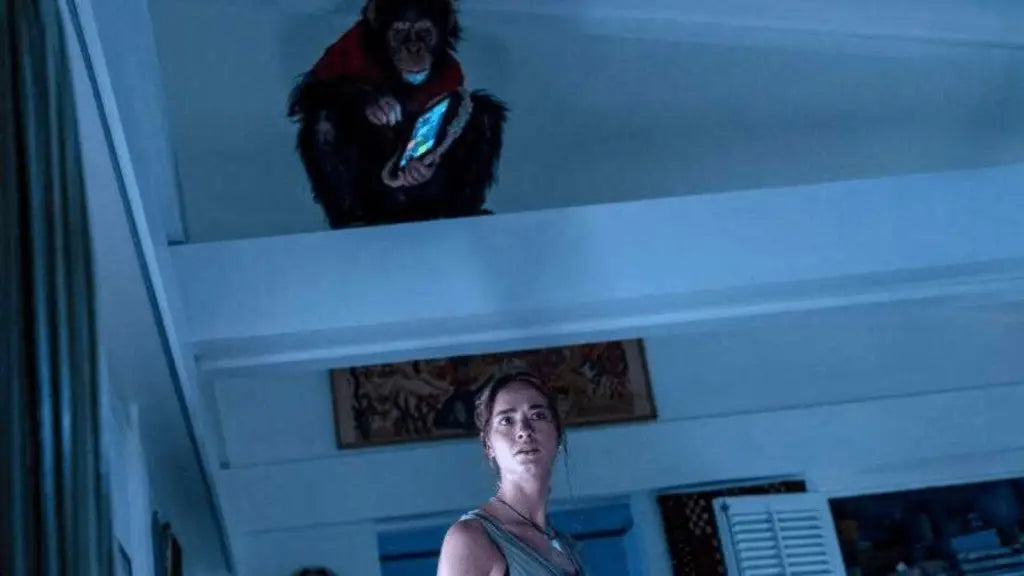
The public image of chimpanzees has never quite recovered from the real-world horror stories that seeped into pop culture consciousness, most infamously the Travis the Chimp incident. The tragedy of those situations is only partly the violence itself; there’s also the confusion and cruelty that precedes it: wild animals forced into domestic roles they cannot possibly understand or truly fulfill. All that said, Primate, the latest scary flick from 47 Meters Down director Johannes Roberts, doesn’t seem especially interested in unpacking that discomfort. Instead, it opts for something closer to Stephen King's Cujo, wherein a beloved family pet becomes infected by rabies, and terror follows.
Ben, the chimp at the center of Primate, and played brilliantly by Miguel Torres Umbra, is introduced as a deeply integrated member of his human family. He communicates through a tablet, shares routines with sisters Lucy (Johnny Suquoyah) and Erin (Gia Hunter), and exists in a strange limbo between animal and sibling. When he’s bitten by a rabid mongoose, the film doesn’t linger much on the tragedy of what that means for him or them. It flips the switch almost immediately, kicking off a lean, mean descent into cruel violence.
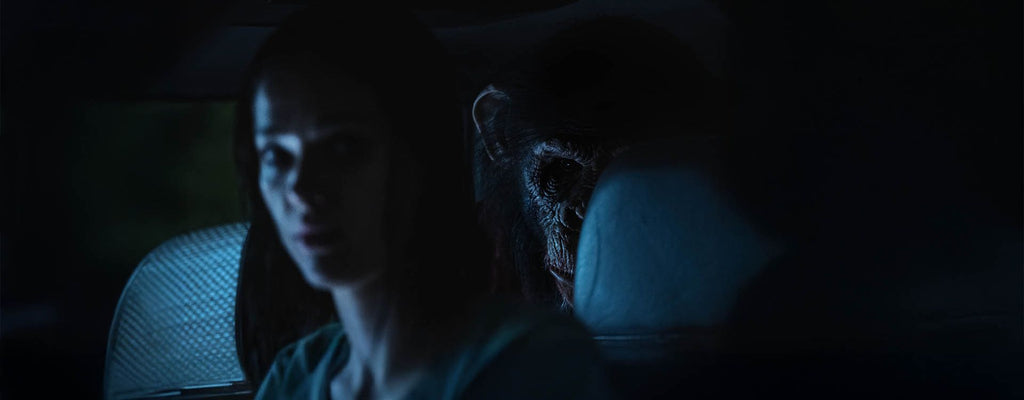
To Primate’s credit, it delivers where it matters most for horror fans: execution. The opening face-mutilation scene is an immediate mission statement: gnarly, practical, and uncompromising. The fully practical chimp suit works shockingly well, grounding the violence in something tactile and real on the screen. There’s excellent use of space within and around the Hawaiian house setting, and once the film locks into siege mode, it creates a genuine “you’re fucked” scenario for its characters. Kinda like Cujo again.
A lot of the tension is terrific. A prolonged hide-and-seek sequence in a closet ranks among the better examples of that trope in recent memory, and the score by Adrian Johnston does heavy lifting throughout, ratcheting anxiety even when the script falters. The problem is that Primate doesn’t seem to know what it wants to do beyond have Ben go ape. The screenplay telegraphs victims too obviously, takes way too long in its final act, and has one too many repetitive sequences. By the end, the film feels drained rather than devastating. It’s more akin to a horror showcase than a satisfying horror story.
Killer Whale, by contrast, is messier and occasionally outright clumsy, but it’s also more ambitious. Writer-director Jo-Anne Brechin sets her sights on an animal whose cinematic reputation is far more complicated. Orcas, for all their size, strength and intelligence, have never killed a human in the wild. In captivity, however, that record changes. In a post-Blackfish world, the idea that a killer whale brutalized by years of confinement might violently turn on humans doesn’t feel like exploitation, it feels like inevitability. That tension genuinely sits at the core of this story, and even when the movie stumbles, it never quite loses sight of that uneasy foundation.
The film opens with an intentionally cheery informational video for “World of Orca,” a SeaWorld-esque theme park where Ceto, the star attraction, has been living and performing tricks for decades. It’s an effective bit of tonal irony, one that quickly curdles as we meet Ceto’s trainers and see her wholly inadequate habitat. There’s a pulpy efficiency to this opening. Ceto stalks trainers and custodians with the exaggerated menace of a slasher villain, and the film leans into that comparison hard.
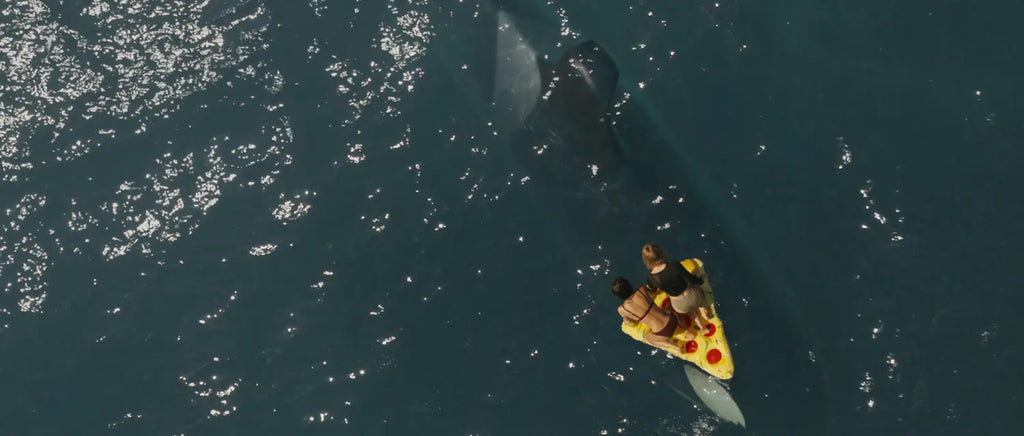
From there however, Killer Whale shifts gears into something more character-driven with the intro of Maddie (Virginia Gardner), a promising musician whose life was shattered only a year earlier. It’s a classic genre setup: some unresolved trauma that will now be followed by significantly worse trauma, as if survival itself might be the cure. Maddie’s best friend Trish (Mel Jarnson), well-meaning but perpetually misreading the room, drags her on a trip meant to honor something Maddie always wanted to do: see the legendary Ceto the whale in person. The intention is sweet.
But what ends up happening is the two girls are trapped in a remote tidal cove with the giant angry mammal herself, and the movie finally locks into place. This is where Killer Whale is at its strongest. The attacks feel distinct from the endless Jaws knockoffs; orcas don’t chomp and retreat, they slam, flip, and drown. Death via orca whale can be much more brutal than most other animal killings, and the imagery of Ceto blasting blood and viscera from her blowhole is absolutely deranged. It’s the kind of B-movie excess that feels tailor-made for midnight screenings.
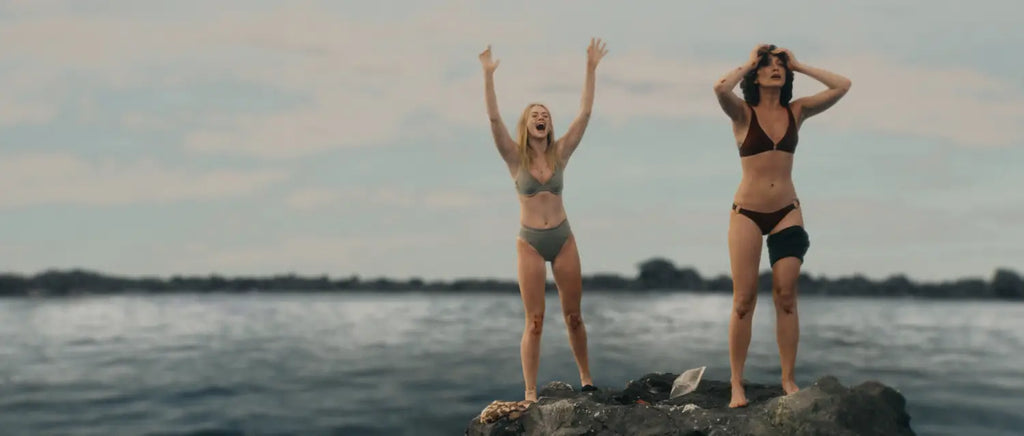
Where Killer Whale stumbles is in polish. Some green-screened shots are distractingly artificial, a couple scenes veer into unintentional comedy, and a late-game emotional goodbye doesn’t feel entirely earned. There’s a frustrating amateurism to certain moments that threatens to undercut the film’s ambitions. But even at its worst, Killer Whale never forgets what it’s circling around: Ceto isn’t just a monster. She’s a victim who justifiably snapped. Her bent dorsal fin sticks out of the water throughout the film as a stark and poignant reminder of exactly that.
That’s ultimately where the divide between these two films becomes clearest. Primate is the sharper horror object. It looks great, stacks up a considerable body count, and is more viscerally effective moment to moment. When it works, it really works. But by the time the credits roll, it feels oddly hollow - a film more committed to momentum than meaning.
Killer Whale, on the other hand, is certainly rougher around the edges, but also more difficult to dismiss. Beneath its SyFy-adjacent trappings lies a creature feature that actually wants to engage with the ethics of captivity and exploitation, even if it doesn’t always articulate them cleanly. It has something on its mind, and that counts for a lot in a genre so often content to simply feed bodies to teeth.
Neither film necessarily transcends its limitations or reinvents the wheel, but together, they highlight the two paths modern creature features tend to take: pure survival horror versus socially conscious monster movies. Primate delivers better scary movie thrills. Killer Whale reaches for something a little deeper to go with its carnage. While neither are especially fantastic, both prove that there’s still life (and a whole lot of blood) left in the subgenre yet.
'Primate' is now playing in theaters.
'Killer Whale' swims into theaters and digital on January 16th.


