

Riding high off the genuinely exceptional drama of last year’s Hedda, Nia DaCosta (Candyman) picks up the baton to the world of Rage with 28 Years Later: The Bone Temple, picking up immediately after the harrowing events of last year’s 28 Years Later. That film didn't just revive this long-dormant franchise, but firmly reasserted it as one of the most emotionally intelligent and artistically daring horror series today. With Alex Garland once again handling the script and DaCosta now stepping into the director’s chair previously occupied by Danny Boyle, the result is something both familiar and thrillingly unexpected.
The big question hanging over The Bone Temple is whether it can carry forward what made 28 Years Later so special: the daring mixed-media cinematography, the heavily layered themes, and the sense that this franchise has matured into something deeper than just people sprinting from infected. While this sequel is less visually experimental (Anthony Dod Mantle passes off cinematography to DaCosta collaborator Sean Bobbitt) it compensates by shifting its focus inward - toward performance, psychology, faith, and the terrifying elasticity of belief in a godless world.
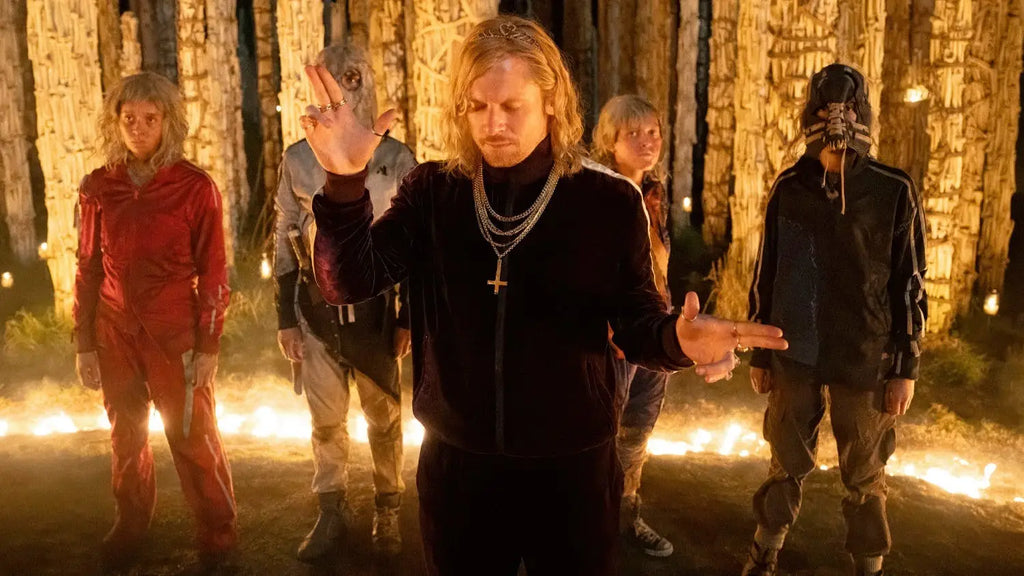
The film opens with a brutally effective introduction to “the Jimmys,” a cult-like collective led by the deeply disturbed and merciless Sir Lord Jimmy Crystal (Jack O’Connell). Poor Spike (Alfie Williams) is subjected to a hazing ritual so cruel and dehumanizing that it immediately reorients the threat of the movie away from infected bodies and toward human cruelty. It’s a grim reminder that survival doesn’t inherently breed morality, it just breeds survivors. Jimmy is vile, manipulative, and monstrous, but The Bone Temple never allows him to be a cartoon. He is, unmistakably, a product of distinct trauma, religious indoctrination, and the psychic damage inflicted by the apocalypse itself.
That moral murkiness extends to the film’s most fascinating relationship: the bond formed between Dr. Ian Kelson (Ralph Fiennes) and the Alpha infected, Samson (Chi Lewis-Perry). Fiennes delivers one of the most remarkable performances of the entire franchise and his own acting career as Kelson, a man clinging to science, memory, and music as lifelines in a world that has long abandoned reason. Through fragmented glimpses of his pre-collapse life (his wife, his career, the records he still plays) and his mostly one-sided talks with Samson, Kelson emerges as a figure defined by grief rather than madness.

Samson, meanwhile, represents one of the boldest ideas this series has ever introduced. Subdued, tranquilized, and spoken to like a person rather than an animal, he begins to respond to Kelson in his own ways. What follows is unsettling, intimate, and genuinely fascinating: a dialogue between man and monster that questions where the virus ends and humanity begins. Their relationship becomes the emotional spine of the film, anchoring its darkest ideas with surprising tenderness, and Lewis-Perry is more than up to the task of matching Fiennes' abilities.
Running parallel to this is Jimmy’s grotesque theater of power. O’Connell, who played another exceptional big screen villain in last year’s Sinners, is outstanding as a cult leader barely holding his fractured philosophy together, terrified of losing control in a world that has already contradicted everything he claims to believe. His pop-culture blasphemy, drawing from his fractured childhood figures like Jimmy Savile and the Teletubbies, is deeply uncomfortable, intentionally absurd, and darkly funny. DaCosta leans into this offbeat humor more than any previous entry in the franchise, weaponizing laughs without ever undercutting the horror.

That tonal balance shouldn’t work, but somehow it does. The Bone Temple is often very funny while also remaining considerably darker than its immediate predecessor. It feels spiritually closer to the original 28 Days Later and 28 Weeks Later in its fixation on the human psyche and the extremes it will reach when stripped of societal structure. An inspiringly deranged torture sequence underscores just how far Jimmy’s worldview has coagulated into cruelty masquerading as faith. Good luck forgetting the sadistic imagery that NaDosca gets on the screen with this one.
Despite all the gnarly post-apocalyptic violence, where the film truly soars is in its conversations. Jimmy’s inevitable exchanges with Kelson are among the best-written scenes Garland has ever delivered for this universe. They help encapsulate the film’s fascination with religion as performance - invented by people, for people - and the possibly dangerous comfort it provides when the world stops making sense. Jimmy leads by cruelty, whereas Kelson leads with kindness, and seeing the two face off in more ways than one is a total thrill.

The climax leans fully into this thematic collision, underscored by a surprising and perfectly deployed Iron Maiden needle drop - one of several in the film that work to startling emotional effect. The music is never just background noise in these films; it’s woven directly into the visuals, characters, and ideas. The Iron Maiden moment in particular is exhilarating, and entirely in keeping with the franchise’s long tradition of unexpected musical punctuation.
28 Years Later: The Bone Temple is not particularly accessible to newcomers, and it’s easy to see why marketing it would be a nightmare. It should be a mess, one overloaded with ideas, tones, and characters, yet DaCosta somehow pulls every thread together into something strangely cohesive and deeply engaging. It may not match the sheer aesthetic audacity of last year’s reinvention, but it compensates by giving its performers space to drive the story and by pushing the franchise’s philosophical ambitions even further.
Like its predecessor, The Bone Temple is genuinely unbelievable to watch at times. Not just as a horror sequel, but as a continuation that dares to interrogate faith, power, and humanity itself. This franchise isn’t just alive. It’s evolving.
'28 Years Later: The Bone Temple' is now in theaters.


