

Darren Aronofsky’s films are rarely subtle, but they’ve always been fearless in how far they’re willing to push the human body and mind. From the harrowing spiral of addiction in Requiem for a Dream, to Natalie Portman’s Nina shredding herself apart for artistic perfection in Black Swan, to Brendan Fraser’s Charlie burying himself under grief and flesh in The Whale, his characters are defined by torment and obsession. His movies often reach for the divine or the cosmic, but always through some very earthly suffering.
Caught Stealing, his latest, might be his most stripped-down movie in decades: a violent, grimy, darkly funny New York crime caper that replaces spiritual yearning with a baseball bat to the ribs. Yet by the time the credits roll, it still feels unmistakably, metaphysically on brand for Aronofsky.
Based on Charlie Huston’s 2004 novel, the film traps Austin Butler’s Hank Thompson in a nightmare of bad luck and bad timing, with New York City circa 1998 as its cruel playground. Hank is a former Giants prospect whose shot at the majors ended in an accident that left him scarred, shaken, and prone to nightmares. These days, he works at a dingy Lower East Side bar, drinking too much and trying to keep up with his paramedic better half, Yvonne (Zoë Kravitz) and calls from his worried mother (Laura Dern). Baseball remains his one source of joy, a bond he still shares with her, but Hank is otherwise a man running on empty. That is, until his eccentric punk neighbor Russ (Matt Smith, complete with mohawk, studded leather jacket, and thick English accent) asks him to watch his beloved cat, Bud (Tonic the Cat of Pet Sematary fame). It’s the kind of favor you can’t imagine leading anywhere - until it does, and violently so.
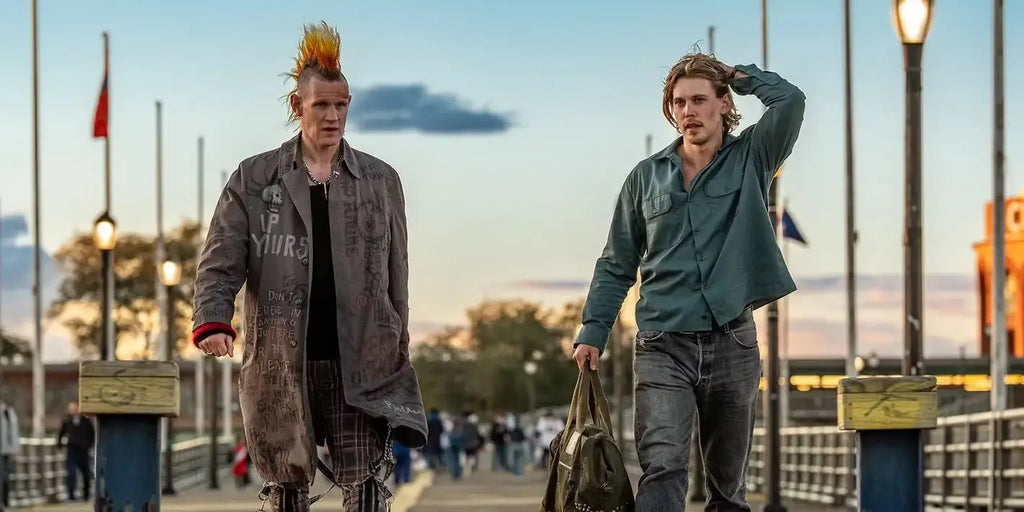
The story, much like Hank’s trajectory, is a steady tumble downhill. Aronofsky and frequent cinematographer Matthew Libatique film this fall with both sadistic grime and surprising wit. The first beating Hank takes, at the hands of Russian thugs looking for Russ, is so prolonged and savage it becomes almost absurd. Butler sells it with exasperated humor as much as pain - this is a man who cannot catch a break, who limps from one fresh injury to another with a defeated shrug. “I can’t afford this, I gotta get outta here before I rack up a bill,” Hank groans after being patched up from near-fatal wounds, forced to leave the hospital thanks to America’s merciless healthcare system. Aronofsky plays moments like these with gallows humor, knowing exactly how to wring laughs from suffering without undercutting the stakes.
The absurdity is amplified by the city itself. New York is rendered here as a multicultural labyrinth of crime, where the Russian mob, corrupt cops, the Hebrew mob, the Puerto Rican mob, and more all collide around Hank’s misfortune. Regina King, as the detective trying to make sense of this mess, cuts through the chaos with cool authority, though even she seems bemused by the sheer scale of it all. Aronofsky and Libatique dive into the grit and neon of late-’90s NYC, capturing chase sequences through bodegas, subways, and dirty apartments with thrilling momentum. The camera never rests, the editing keeps the pulse racing, and the soundtrack - a snarling, propulsive set of tracks from British post-punk band Idles - injects pure adrenaline. It’s the kind of music that rattles your bones, and it matches the film’s bruised energy perfectly.
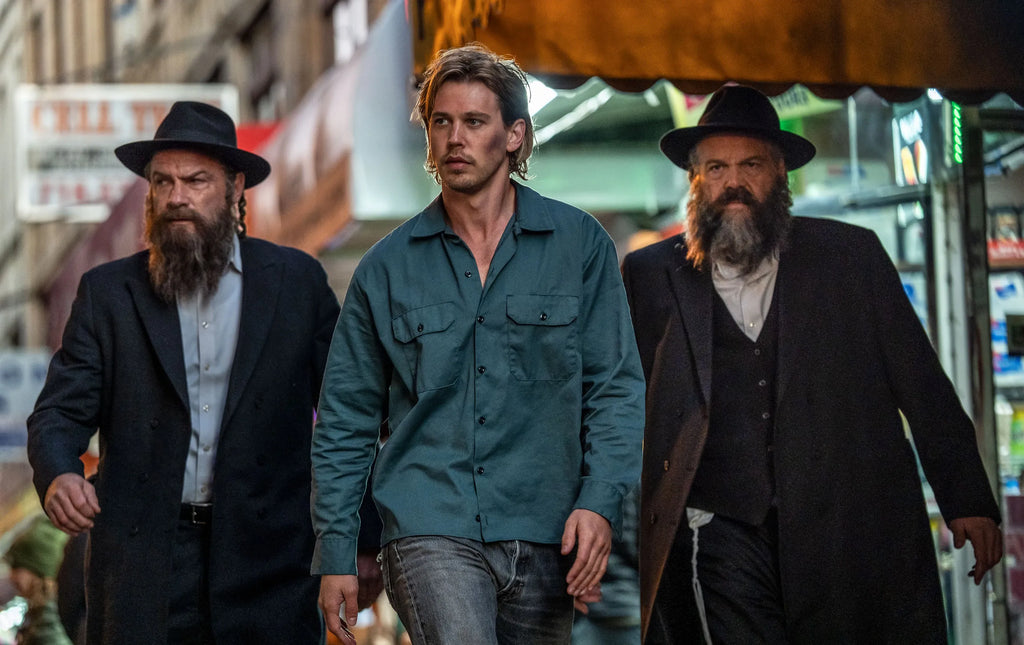
At the center of this is Butler, who proves again that he’s more than just a matinee idol. Hank is constantly beaten, bloodied, humiliated, and haunted, but Butler plays him not as a stoic hero but as a deeply unlucky everyman. His golden boyish charm - the same quality that made him a striking Elvis Presley - is stripped raw here, revealing fear, guilt, and exhaustion. What makes Hank compelling is that he’s genuinely not built for this world of crime; he’s terrified, openly admitting as much, yet he can’t stop himself from caring. His decency is both his greatest strength and his Achilles heel. He looks after Bud with tenderness, tries to protect those he cares about even remotely, and consistently puts himself in harm’s way to do the right thing. That’s exactly why the violence around him cuts so deep - Aronofsky makes it abundantly clear that good intentions won’t save you when you’re caught in the wrong web.
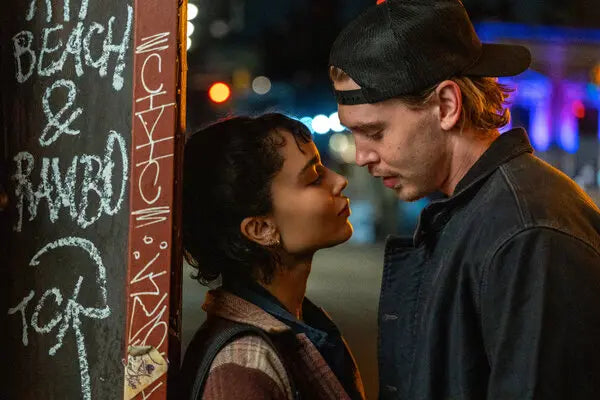
Thankfully, Hank isn’t entirely alone. His chemistry with Kravitz’s Yvonne gives the film its brief moments of warmth and legitimate sexiness. Their flirtations are charged, their intimacy fiery yet tender, but like everything in Hank’s orbit, he knows it’s likely doomed. A standout sequence sees Hank, laden with despair, go on a hard night’s bender, with Yvonne desperately trying to help him as the world spins around them. The cinematography here is dizzying, both beautiful and suffocating. Hank is a man both running from and drowning in guilt, and Butler shoulders that weight with remarkable, almost holylike vulnerability.
If Caught Stealing doesn’t always reach the emotional highs of Aronofsky’s best, it’s because the film is ultimately more interested in momentum than transcendence. This is less The Fountain and more After Hours by way of Uncut Gems, a relentless cascade of chaos with the occasional poetic beat. The violence is brutal, the chases inventive, the body count ever-rising, but Aronofsky never lets it feel gratuitous. Every punch, every bullet, every swing of a baseball bat lands with real weight. It’s the kind of movie where you flinch with every hit.
By the time the dust settles, Hank has lost nearly everything, yet he still finds the will to keep swinging. It’s a sentiment ripped straight from his love of baseball: no matter how many strikes, you step up to the plate again. That blend of bleakness and stubborn perseverance is what makes Caught Stealing linger. Aronofsky doesn’t offer salvation, only survival - a vision of New York where cruelty and absurdity walk hand in hand, and where even the smallest act of kindness can spiral into catastrophe. It’s a viciously funny, bruising reminder that life has a way of beating you down, but sometimes the only answer is to get back up and take another swing.
While the film may not be especially moving or revelatory, it’s undeniably gripping - a chance to see one of American cinema’s great maximalists let loose in a genre playground, armed with style, wit, and a cat who somehow steals every scene.
‘Caught Stealing’ is now playing in theaters.


