

There’s a moment early in Edgar Wright’s The Running Man where Glen Powell, impossibly chiseled and perfectly coiffed even under layers of fabricated future-grime and supposed extreme poverty, tries to blend into the slums of a dying America. It’s the kind of image that shouldn’t work - Powell is simply too movie-star handsome to believably pass as someone scraping to survive - but you’re mostly able to buy into it anyway because Wright sells the world around him so completely. This dystopia, all flickering propaganda screens, endless game-show noise, and an apathetic, bloodthirsty public, is bleak in ways that are uncomfortably familiar. It’s exaggerated, sure, but only by a few inches. The movie doesn’t ask, “What if our world got worse?” so much as it wonders aloud whether it already has.
Wright (Shaun of the Dead, Scott Pilgrim vs. the World, Baby Driver) has always been a maximalist, and adapting Stephen King’s uniquely prescient 1982 novel gives him the perfect sandbox to blow out every instinct he’s ever had about media saturation, spectacle, and the creeping rot of entertainment dressed up as civic duty. The film walks a tightrope between doom and adrenaline: half righteous fury at the systems crushing ordinary people, half playful, propulsive genre fun. When that balance works, it really works. The first hour is some of the most immediately entertaining filmmaking Wright has delivered from an already illustrious career. The editing by Wright’s frequent collaborator Paul Machliss is razor-sharp and wild without ever being incoherent, and the movie throws so many inventive reality shows, propaganda reels, and deranged pieces of pop-programming at you that it becomes its own kind of hypnotic world-building. Wright is clearly having a blast as he so often does in his films, and it’s contagious.
Ben Richards (Powell) is introduced not as a revolutionary but as an everyday good guy struggling in a bad world, the kind of man who’ll risk everything just to return his daughter’s missing sock. His moral compass is intact even as his anger often boils over in one way or another, and Powell’s magnetic charm does a lot of heavy lifting in getting you on his side. Between this and Hit Man, he seems to be cornering the market on characters who slip into goofy costumes and accents without ever losing the emotional spine of the serious story being told. He’s a magnetic lead, even if the movie around him veers off-course.
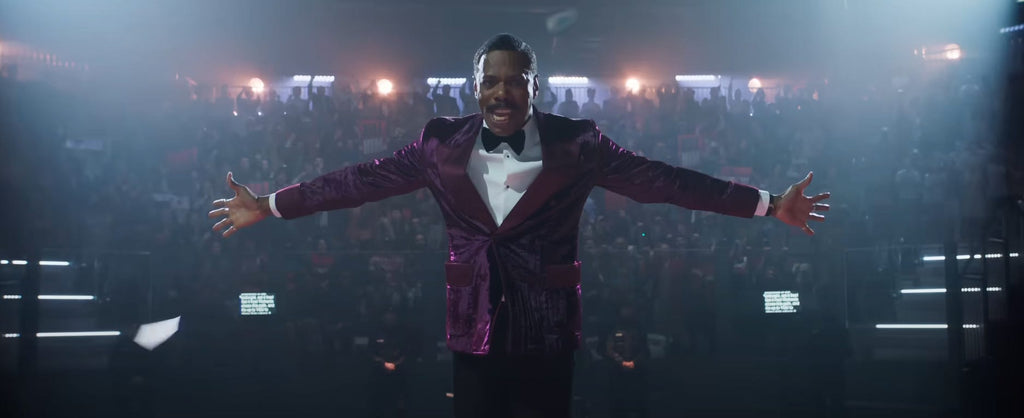
The supporting cast is stacked with people who know exactly what kind of heightened satire they’re in. Katy O’Brian (Love Lies Bleeding, Queens of the Dead), in particular, has a screen presence that could cut through steel as fellow Running Man contestant Jenni Laughlin. Michael Cera shows up with some hilariously brittle line deliveries (“She used to be a kind, clever woman,” he laments about a bigoted elder whose brain has been curdled by state-sponsored media), a joke that lands but also stings with depressing accuracy. And Colman Domingo, unsurprisingly, steals every frame he appears in as eccentric host Bobby T. There’s a viciously funny edge to a lot of Wright’s world-building - the graffiti reading “AGAB (All Goons Are Bastards)” almost dares you not to chuckle at how thin the metaphorical veil has gotten, and the AI deepfakes that slander Ben on the nightly news feel like Wright winking at us from the editing bay: “If this isn’t happening yet, give it a week.”
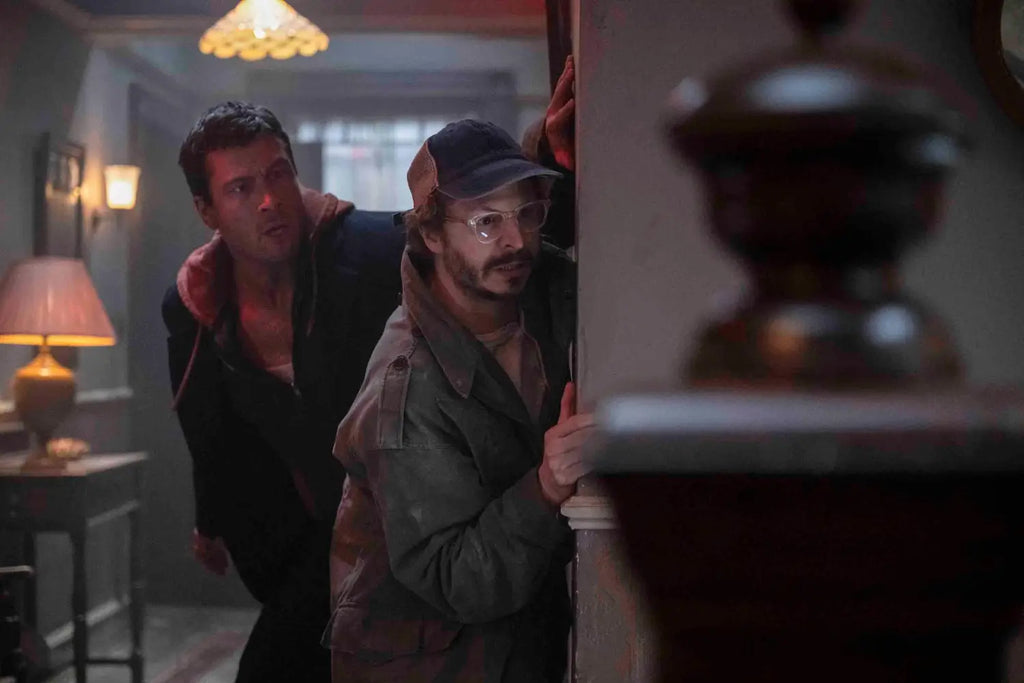
It all feels frighteningly relevant, but Wright never lets the social commentary get too heavy (or heavy-handed) in the early going. The brutality of the Running Man game show is filtered through a crisp, kinetic sense of entertainment; the kind that’s genuinely easy to get swept up in. The jingoism is loud and proud, the production design is loud and proud, even the Monster Energy product placement is loud and proud, and that’s part of the joke: a world screaming at you nonstop until you're numb. It’s exhilarating and sickening, sometimes at the same time. But once the film enters its back half, that tightrope gets shakier.
The story’s natural arc requires the spectacle to give way to something far angrier and more incendiary. That’s the text of the novel and it’s the DNA of the premise. But Wright’s strengths reveal themselves to lie much more in the gleeful chaos of action-comedy than in sustained revolutionary rage, and the tonal shift isn’t as smooth as it needs to be. The moment Richards takes a privileged young woman hostage (Emilia Jones), the movie starts to lose control of its rhythm. The commentary turns blunt, the humor retreats, and the emotional momentum sputters. It’s not that Wright can’t do dark (plenty of moments in his other films prove otherwise) it’s that The Running Man feels uniquely strained when it tries to thread the needle between “burn it all down” fury and the popcorn-fun energy that defined its great first hour.

You can feel the film pushing toward an intended grand statement about the hopelessness of the American dream and media cycles and the ways the powerful chew up the desperate, but the third act softens into something strangely muddled. Moments that should hit with force come off as a bit awkward instead, especially in the way Richards attempts to “teach” the captive woman a lesson about inequality. It’s a scene that wants to critique privilege and complacency with injustice but lands with a thud, mostly because the movie itself suddenly stops being funny or sharp, unsure of whether it wants to inspire real anger or cut the sincerity with satire. The final moments, bizarrely misjudged in tone, only underline that struggle.
For all its shortcomings, The Running Man remains a crowd-pleaser for the most part, one with its heart, and its head, in the right place. Wright’s vision of a country ready to explode feels depressingly accurate, and he captures the oppressive noise of our oversaturated media ecosystem with a clarity that’s equal parts hilarious and bleak. Even when the film tips too far toward misguided self-seriousness, the core message lands: in a world where poverty becomes spectacle and suffering becomes content, the only way to win is to survive long enough to expose the rigged game at play.
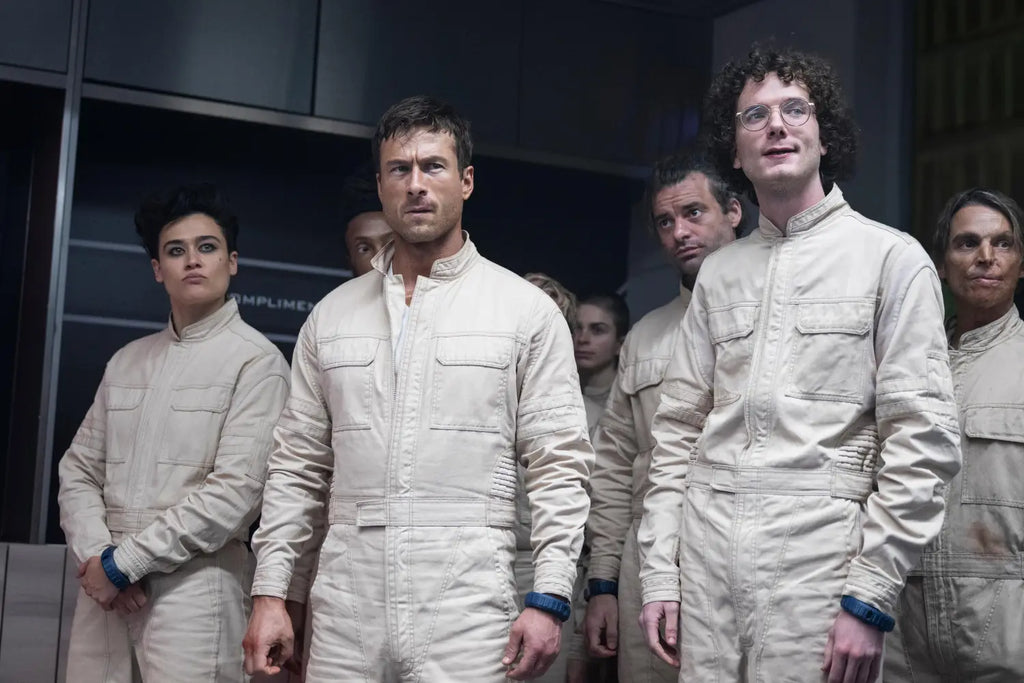
While Wright’s adaptation may not perfectly fuse its incendiary impulses with its need to entertain, it still carries the unmistakable pulse of a filmmaker trying to say something urgent about the moment we’re living through. Quite the trend for the year 2025. I just wish it trusted its strengths a bit more and leaned harder into the zany, biting, neon-soaked action and less into the preachy righteousness that bogs down its third act. Because when this movie is fun, it soars. When it gets angry, it wants to punch through the screen. It’s the attempted marriage of the two that never quite clicks the way it could.
But even with a shaky landing, Wright’s The Running Man can leave you buzzing. The satire hits more often than not, the craftsmanship dazzles, and the story itself is airtight. If the revolution is coming, at least this version of The Running Man gives you something thrilling to watch while you wait - or get inspired enough to participate.
'The Running Man' is now playing in theaters.


