

The latest film adaptation of Frankenstein is a gothic melodrama full of grave robbing, surgical mutilation, emotional manipulation, and a wondrous central performance at the heart of it all. Guillermo del Toro has crafted a lush, beautifully mounted new take on Mary Shelley’s legendary classic that doesn’t just resurrect a familiar monster, but also prods at the complicated, often contradictory bonds we share with the people who made us who we are. Which, if you think about it, is exactly the emotional minefield we willingly walk into every November.
This version kicks off with an exhilarating action sequence in the icy tundras near the North Pole, as brilliant scientist Victor Frankenstein (Oscar Isaac) is chased across the frozen expanse by the Creature he tried (and failed) to destroy. The sequence is pure cinematic adrenaline, but what sticks with you even more is the artistry of every frame thereafter. You could pause the film at almost any moment and wind up with an oil painting. From the frozen blues of the opening to the candlelit browns and reds of Victor’s family estate, the film’s production design and costume work are nothing short of staggering. It’s the kind of film that feels truly handcrafted; stitched together with an almost obsessive attention to detail, much like Victor’s own creation.
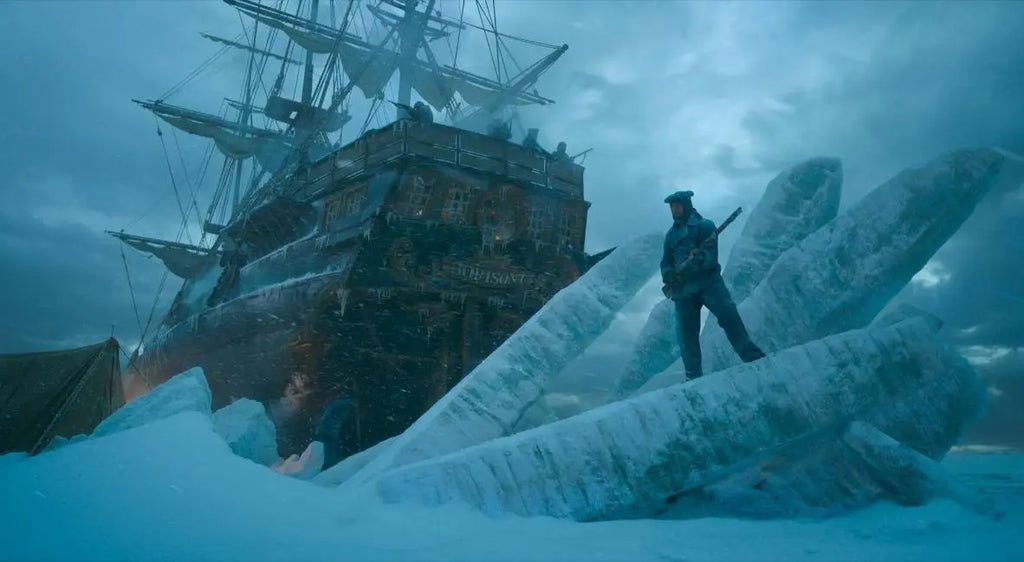
For all its visual decadence, this adaptation thankfully isn’t content to simply dazzle. It takes cues from the stylings of del Toro’s previous works like Crimson Peak and Pinocchio, leaning into a lush gothic-romantic sensibility, while grounding the story in fragile, very human emotions. Victor narrates the tale from the end of his rope - literally stranded at the top of the world - and the film rewinds to his beginnings. The first act, admittedly, could use a tighter pace. But it does succeed in something many adaptations miss: making Victor feel like a fully formed person. He’s sympathetic here, even heartbreakingly so, shaped by a ruthless physician father (Charles Dance) whose “lessons” in anatomy and surgery border on abuse. Victor’s mother dies in front of him when he’s still young, a trauma the film wields like a key in the way it unlocks everything that comes after.
Christoph Waltz shows up, injecting the screen with his unique brand of energy as Henrich Harlander, the wealthy patron funding Victor’s increasingly deranged experiments and the uncle of Elizabeth Harlander. Elizabeth, played with moral sharpness and warmth by Mia Goth, serves as Victor’s mirror image: brilliant, empathetic, devoted to the preservation of…well, everything he takes for granted. The not-so-subtle casting choice of Goth in the dual roles of both Elizabeth and Victor’s late mother adds a deliciously Freudian undercurrent. Victor wants Elizabeth not simply because she’s engaged to his brother William (Felix Kammerer) but because in her he sees the only unconditional love he ever knew. It’s skin-crawling and sad and human in equal measure.
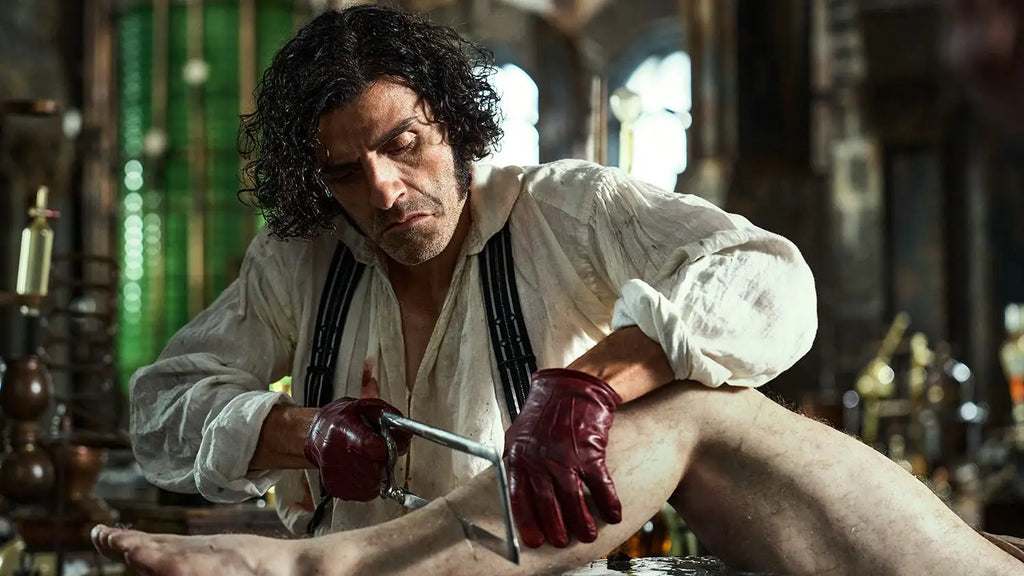
Once Victor begins scoping out bodies on death row and battlefields, essentially window-shopping for limbs, the film shifts gears into something closer to horror. The montage of him hacking, sawing, stitching, peeling away skin and sinew is somehow both grotesque and oddly delightful, aided by a propulsive score by Alexandre Desplat that’s reminiscent of the old Danny Elfman / Tim Burton collaborations. The gore is abundant in this stretch of the movie, but it certainly fits. There’s a mad artistry here, a sense of a man trying to sculpt his loneliness into something that can love him back. Which, of course, leads us to the Creature.
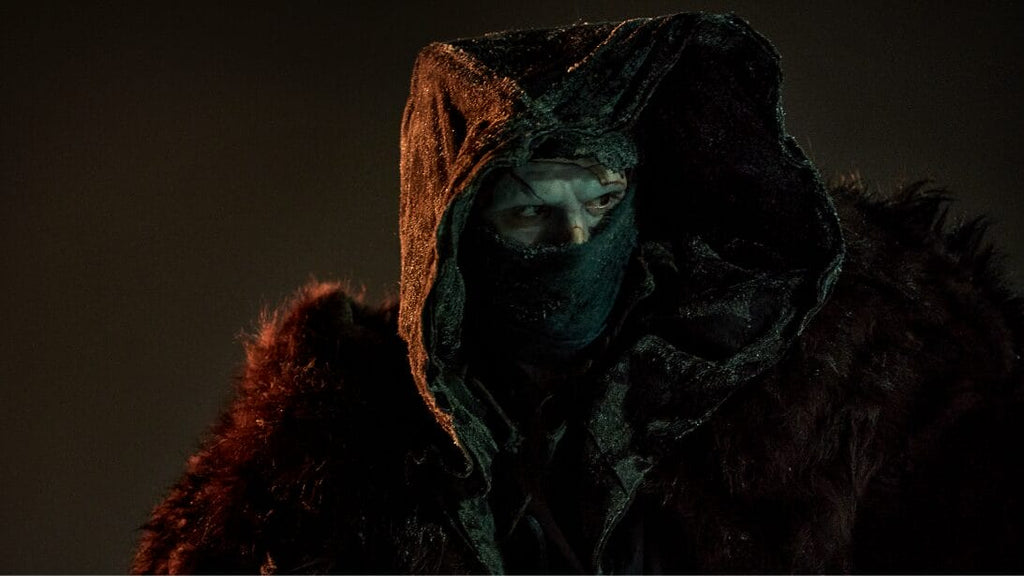
Their initial meeting is shockingly tender, a quiet moment played without irony. Victor treats him like a son, and for a moment the film hints at the possibility of something close to love. But as the Creature (played with heartbreaking hurt by Jacob Elordi) fails to learn or behave according to Victor’s desires, the fragile bond sours. Kindness exists only in Elizabeth’s orbit; cruelty seems embedded in Victor’s. The Creature, only able to speak names at first, reaches instinctively toward gentleness. It’s no surprise, then, that when Victor burns down his own tower in an angry panic, he makes a last-second attempt to save the being he just tried to kill, simply because he hears it cry out his name.
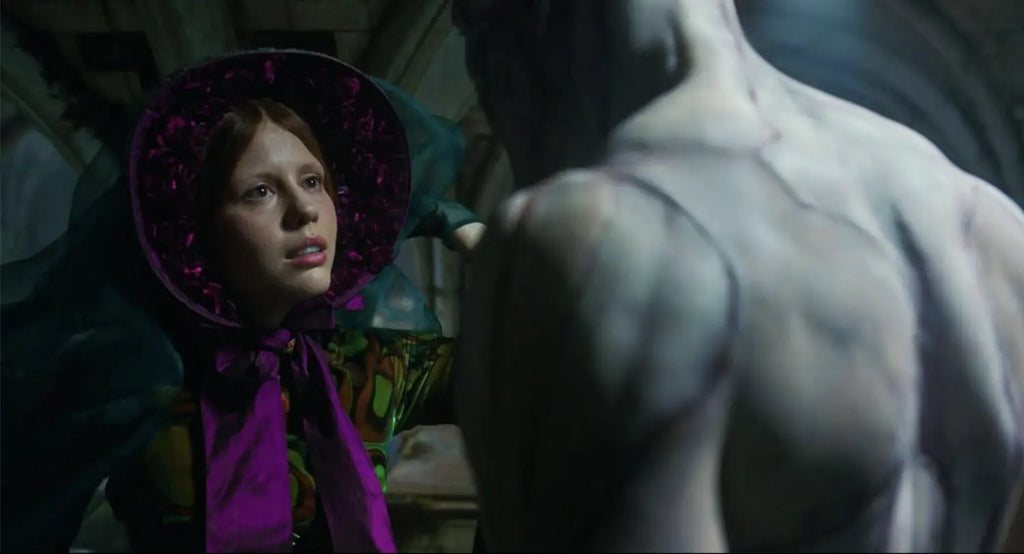
The film’s bifurcated structure splits the story in two: Victor’s descent and the Creature’s rise. The second half belongs to the Creature entirely, following his lonely wanderings through the woods and his eventual education under a blind patriarch (David Bradley). These scenes hold a quiet, aching beauty, though the film’s runtime definitely continues to show its seams here. It’s overlong in ways that don’t always justify themselves. For all its aesthetic and emotional richness, the narrative pacing struggles to stay lively, often feeling safe and predictable where it could be sharper or more experimental.
But the film finds its soul again in the final stretch, culminating in a confrontation that feels both inevitable and surprisingly compassionate. “Victor, you only listen when I hurt you,” the Creature says - a line that cuts deeper than any scalpel Victor ever held. The final exchange between the two is unexpectedly tender. Victor apologizes. The Creature forgives. Two creations of the same violent household finally recognizing the humanity in each other.
And here’s where the Thanksgiving angle stops being a joke and starts being the whole point.
Frankenstein is a film about inherited pain. It’s about the things our families pass down to us without meaning to, and about the damage we replicate in our attempt to outrun it. It’s about trying, and failing, and trying again to show kindness. It’s about people who hurt each other because they’ve never really learned how to do anything else. And ultimately, it’s about forgiveness. Not easy or sweeping, but small and internal, the kind that matters the most.
So yes, watch Frankenstein this Thanksgiving. Watch it before or after you sit across from the people who made you, for better or worse. Watch it as a reminder that even broken things can offer grace. Watch it because it’s gorgeous, ambitious, messy, and full of humanity. Watch it because, in its final moments, it insists that we are not doomed to repeat the cruelty we were raised with.
And really, what’s more Thanksgiving than that?
‘Frankenstein’ is now streaming exclusively on Netflix.


